
How Law Firms Rank in ChatGPT, Perplexity and Gemini

How Law Firms Rank in ChatGPT, Perplexity and Gemini

There is no ranking in ChatGPT, Perplexity, or Gemini. Not one of the three publishes a ranking algorithm, two of them do not query the same index, and what each vendor does publish is documentation about retrieval.

That gap between what firms are told and what the vendors have written down is why a practice can sit at position one on Google and never surface in a ChatGPT answer. We work from those vendor documents at Lexicon Legal Content rather than from other agencies’ summaries of them, and the three engines diverge further than the marketing around them admits.

Q Short Answer

ChatGPT, Perplexity and Google run on three separate indexes served by six separate crawlers, so there is no single ranking for a law firm to optimize toward.

Each vendor publishes retrieval documentation rather than a ranking algorithm, and those documents contradict a good deal of the advice sold to law firms.

ChatGPT Runs on Someone Else’s Index

OpenAI does not operate a search index of its own for ChatGPT search. Its documentation states that ChatGPT search leverages third-party search providers along with content supplied directly by partners, and OpenAI’s help documentation names Bing as one of those providers.

OpenAI publishes four separate bots, and the difference between two of them corrects the most common mistake in law firm marketing. GPTBot is described as crawling content that may be used in training foundation models, while OAI-SearchBot is described as surfacing websites in ChatGPT’s search features.

Blocking GPTBot therefore does not remove your firm from ChatGPT search. Plenty of firms have been told otherwise, and a few have blocked the wrong agent on that advice, which is a costly way to lose the visibility inside ChatGPT results they were paying to build.

Perplexity Scores Passages, Not Pages

Perplexity runs its own index and evaluates your content in fragments. Its engineering documentation describes an index covering hundreds of billions of webpages, and states that its retrieval infrastructure divides documents into fine-grained units that are individually surfaced and scored against the query.

That single sentence is the only vendor-documented argument for answer-first writing that exists across any of the three engines. If the scoring unit is the passage, a self-contained paragraph naming the jurisdiction and the standard is the asset, and the page around it is packaging.

Perplexity’s crawler behavior also differs from OpenAI’s in a way worth noting before anyone edits robots.txt. PerplexityBot is documented as not being used to crawl content for foundation models at all, so there is no training-versus-search split to manage.

Google Wants Nothing Special From You

Google’s position is that AI Overviews and AI Mode require no separate optimization. Its documentation states there are no additional requirements to appear in either surface and no other special optimizations necessary, and that a page must be indexed and eligible to appear with a snippet.

The mythbusting in Google’s guidance on helpful content and its generative AI guide kills several paid recommendations at once. No AI text files, because Google Search does not use them. No required structured data. No requirement to fragment your content.

One line settles the argument firms have been having since Google-Extended appeared. Google states that Google-Extended does not affect a site’s inclusion in Google Search and is not used as a ranking signal, which means blocking it protects nothing about your AI Overview presence and costs nothing either.

What Actually Differs, and What It Changes

Three architectures produce three different jobs. ChatGPT depends on an index it does not own, Perplexity owns its index and scores passages inside it, and Google runs retrieval over the same ranking systems that already decide your organic position.

The practical consequences separate cleanly. Bing indexation matters for ChatGPT, though OpenAI has never stated it as a requirement and anyone claiming otherwise is inferring. Passage-level structure matters most for Perplexity. For Google, ordinary indexing and snippet eligibility are the whole technical story.

There is a shared failure mode underneath all three. Vercel and Merj measured AI crawler behavior in December 2024 and reported that none of the major AI crawlers rendered JavaScript, which means the client-rendered attorney bios, accordion practice area pages, and review widgets common on law firm sites are invisible to two of these three engines.

That makes a firm site’s structure a retrieval question rather than a design one. Orphaned pages and content that only exists after a script runs are content these crawlers never see.

The Legal Wrinkle Nobody Gets Right

Legal content is treated as high-stakes, but not the way the industry says. Google’s Search Quality Rater Guidelines name four categories in the your money or your life section, being health or safety, financial security, government and civics, and other, and “legal” is not one of them.

Legal content lands inside those definitions rather than beside them. An injury or bankruptcy matter is financial security; an immigration or criminal matter is government and civics. Saying that precisely is more accurate than the shorthand every competing page uses.

Authorship is the one signal with real documentation behind it, and only from Google, whose guidance asks whether it is self-evident who authored the content and whether bylines lead to further information about the author. OpenAI and Perplexity publish nothing equivalent, so attorney bylines are a documented Google signal and an educated guess everywhere else.

Building verifiable credibility signals is therefore worth doing for Google’s stated reasons rather than for a claim about ChatGPT that no vendor has made. The work is the same either way.

Frequently Asked Questions

Does ChatGPT use Google’s rankings?

No. OpenAI documents that ChatGPT search draws on third-party search providers and content supplied by partners, naming Bing among those providers. Your position in Google’s organic results carries no documented weight inside ChatGPT’s own retrieval process.

How long does it take to show up?

The answer differs by engine. Perplexity states its index processes tens of thousands of update requests per second, Google follows its ordinary crawl and index cycle, and OpenAI documents no timeline because it depends on another company’s index.

Should we block AI crawlers?

The evidence is genuinely unresolved. Blocking a training crawler has not reliably removed sites from citations in published testing, while blocking a retrieval crawler correlates with near-zero citations in the one study that normalized for site prominence.

Key Takeaways
1ChatGPT retrieves through third-party providers, Perplexity retrieves from its own index at passage level, and Google retrieves over its core search ranking systems.
2GPTBot crawls content for model training while OAI-SearchBot serves ChatGPT search, so blocking the first does not remove a firm from the second.
3Google states that Google-Extended does not affect a site’s inclusion in Google Search and is not used as a ranking signal.
4The firms visible across all three are the ones whose pages are readable without JavaScript and quotable one passage at a time.

Give Your Developer Something Specific

Almost none of this is a marketing task. It is a list for whoever maintains the site: confirm OAI-SearchBot and PerplexityBot can reach the pages, verify Googlebot indexing and snippet eligibility, and identify the content that only exists once a script has run.

We produce that list, line by line, in a form an engineer can work through. Anything we then write to fill the gaps is checked by a licensed attorney before it ships, so the fix does not create a bar problem while solving a crawler one.

Once access is sorted, the metrics worth tracking split by engine, and we set that up in the same pass. Call 877-486-8123 and ask for the crawler check, or take a free sample first.


David Arato, JDs headshot

David Arato, JD is the founder of Lexicon Legal Content, an attorney-owned legal content marketing agency serving law firms since 2012. He developed Lexicon’s approach to SEO, AEO, and GEO around the credibility, clarity, and consistency signals that can strengthen a firm’s visibility across search and AI-driven platforms. David is a frequent contributor to Attorney at Law Magazine and Attorney at Work and a recurring guest on legal marketing podcasts.

Local SEO for Personal Injury Lawyers: How AI Decides Which Firm to Name in Your City

A legal directory was the first source cited in 77.8 percent of AI answers to city-level personal injury queries, across 540 queries run in 30 US metros. Identifiable law firm websites accounted for 7.5 percent of the citations in that same test.

Which injury firm gets named in a given city, then, is mostly decided somewhere other than that firm’s website. Local budgets are rarely pointed there, and the firms arriving at Lexicon Legal Content tend to have a clean site alongside a directory footprint nobody has opened since 2019.

Q Short Answer

AI assistants name the personal injury firm they find in a legal directory profile far more often than the one they find on a law firm website.

City-level visibility is settled in the directory layer and the Google Business Profile before it is settled on your own pages.

AI Does Not Answer “Personal Injury Lawyer Near Me”

Google still hands the raw local query to the map pack, not to an AI answer. Whitespark tested 540 queries across three cities in six industries including personal injury lawyers, and found AI Overviews appeared on 15% of local-intent queries while local packs appeared on 93%.

Flip to hybrid questions and the picture inverts. “Best car accident lawyer in Houston for a rideshare crash” returned an AI Overview 97% of the time and a local pack only 17% of the time.

So AI is not competing for the hire query. It is competing for the question a person asks right before the hire, which is where a small firm’s depth in one local market either shows up in the content or does not.

Your Google Business Profile Now Feeds Both Surfaces

Google names the profile as a mechanism for both. Its generative AI guidance says that using products including Google Business Profile helps services appear in AI responses and other search results, and its local ranking documentation ranks profiles on relevance, distance, and prominence.

Two rules in Google’s own business representation guidelines are broken constantly by personal injury firms. Business names may not contain location or service keywords, which makes “Smith Law, Miami Car Accident Lawyers” a violation, and an individual attorney may hold a separate profile only if they operate in a public-facing role and can be reached at the verified location during stated hours.

Then there are hours. Most personal injury firms advertise round-the-clock intake and list nine to five on the profile, which is a five-minute fix sitting untouched in almost every account we open.

Directories Are Where AI Reads Your Firm’s Name

The citation layer for city-level lawyer queries belongs to directories, not law firms. InterCore, a vendor that sells AI visibility services to law firms, ran 540 queries across 30 metros through Perplexity in July 2026 and reported that a legal directory was the first source cited in 77.8% of answers, with identifiable law firm websites accounting for 7.5% of citations.

A second study points the same way with different engines. Citorian logged 359 answers across five assistants in five metros in June 2026 and found Super Lawyers cited in 33% and Justia in 20%, ahead of every firm website tested.

Both vendors sell services these findings happen to justify, so treat the direction as reliable and the decimals as marketing. The practical read is unchanged: fix Justia and Super Lawyers before you rewrite another blog post, because directory listings and content are doing different jobs and a firm needs both.

The Compliance Problem Hiding in Your Directory Bio

Stale directory language becomes a repeated advertising communication once an AI starts quoting it. ABA Model Rule 7.2(c) prohibits a lawyer from stating or implying certification in a particular field of law unless the lawyer has been certified by an organization approved by an appropriate authority, and that organization is clearly identified in the communication.

Read your Avvo and Justia bios with that rule open. Any phrase claiming certification without naming the certifying body is a problem your state bar already recognizes, and assistants reproduce that phrasing verbatim into answers you never see.

This is why we treat directory cleanup as a compliance task at Lexicon Legal Content rather than a marketing one. Rules 7.1 through 7.3 already govern what a firm may advertise, and several states tighten them further, so the exposure scales with every answer an assistant generates.

Ranking on Google Does Not Put You in ChatGPT

The two run on different retrieval systems, and one fact from OpenAI explains most of what firms find confusing. OpenAI documents that ChatGPT collects general location information from a user’s IP address and may share it with third-party search providers, which is why the same question returns different firms in Tampa and Denver.

OpenAI also documents four separate bots, and the distinction matters for anyone who has blocked one. GPTBot crawls content that may be used to train foundation models, while OAI-SearchBot is the agent that surfaces websites in ChatGPT’s search features, so blocking the first does not remove you from the second.

One correction while you are in the markup. Schema.org deprecated the `Attorney` type with the note that LegalService is more inclusive and less ambiguous, yet most published local guides for personal injury firms still recommend Attorney.

Getting the type right matters more for injury firms than for most practice areas, because the co-citation patterns in injury search put your firm name beside the same directories over and over.

Frequently Asked Questions

Does ChatGPT use my Google Business Profile?

Not in any documented way. OpenAI says only that it partnered with providers on categories including maps, and has never named the provider. What it does confirm is live web search through third-party providers and location inferred from IP address.

Should each of our attorneys have a separate Google Business Profile?

Only if the attorney works in a public-facing role and can be contacted directly at the verified address during the hours listed. Google applies both conditions, and profiles failing either one risk suspension.

How long after fixing directory listings will AI answers change?

No platform publishes a refresh interval, so any specific number you are quoted is invented. Perplexity states its index processes tens of thousands of update requests per second; OpenAI and Google document nothing comparable.

Do I need Attorney schema to be cited by AI?

No, on two counts. Schema.org has deprecated that type in favor of LegalService, and Google states plainly that structured data is not required for generative AI search and no special markup exists for it.

Key Takeaways
1A legal directory was the first source cited in 77.8% of AI answers to city-level injury queries, while law firm websites accounted for 7.5% of citations.
2Google shows an AI Overview on 15% of local intent queries but 97% of hybrid ones, so AI competes for the question asked just before the hire.
3ABA Model Rule 7.2(c) prohibits implying certification without naming the certifying organization, and assistants reproduce directory bio language word for word.
4The firms that get named are the ones whose Justia, Super Lawyers and Google Business Profile records match each other exactly.

Three Checks You Can Run This Week, And The One We Run

The audit above takes about 45 minutes and will tell you whether your problem is the website or the directory layer. Our version covers every city page and every profile at once, logs the citation list on each query rather than the answer, and comes back naming the listings that are keeping your firm out of the results.

A licensed attorney reviews every page before it reaches your site, which matters more than usual here, because the fix runs through bar-regulated language in a bio. Anyone who wants to keep going alone can work from our full audit method. To hand it over instead, the number is 877-486-8123.


David Arato, JDs headshot

David Arato, JD, is the founder of Lexicon Legal Content, an attorney-owned legal content marketing agency serving law firms since 2012. He has spent years inside the local search files of injury firms in crowded metros, where the difference between being named and being invisible usually sits in a directory profile nobody owns. David is a frequent contributor to Attorney at Law Magazine and Attorney at Work and a recurring guest on legal marketing podcasts.


SEO for Personal Injury Law Firms in the AI Age: What Google Actually Says

Personal injury firms are buying AI schema packages that Google’s own documentation says are not required. That documentation was updated on July 10, 2026, and it states that structured data is not needed for generative AI search and that no special schema.org markup exists for it.

In a category where one paid click runs about $75, that money comes out of something. In nearly every injury audit that crosses our desk at Lexicon Legal Content, it comes out of the pages that were actually signing cases.

Q Short Answer

Google’s own documentation states that structured data is not required for generative AI search, so the schema packages sold to personal injury firms for AI visibility are not what earns the citation.

AI Overviews take clicks from informational blog content at roughly five times the rate they touch commercial queries, which changes what a firm should fund.

What AI Search Changed for Personal Injury Firms, and What It Did Not

AI Overviews are taking the top of your funnel, not the bottom. According to Ahrefs, which analyzed 146,122,391 search results in September 2025, AI Overviews appeared on 21.4% of informational queries but only 4.3% of commercial ones.

Map that onto a personal injury practice. “How long do I have to file a claim” and “what is my case worth” sit in the 21.4%. “Car accident lawyer in Fort Lauderdale” sits in the 4.3%.

That split carries a budget consequence most firms have not drawn. A blog library built over a decade around the exact informational questions AI now answers on the results page is a depreciating asset, and the practice area pages nobody has touched in two years are not.

Ranking First No Longer Wins the Citation

A top-ten position has become a weak predictor of whether Google’s AI cites you. Ahrefs analyzed 863,000 search results and four million AI Overview URLs in March 2026 and found 37.9% of cited pages were ranking in the first ten results, down from the 76% it reported in July 2025.

Read that drop carefully, because the honest version is less dramatic than the version being quoted at you. Ahrefs’ own authors point out that the earlier study sampled only the three most visible citations per response, and that the company has since improved how it parses citations. Part of the decline is method, not Google.

The mechanism behind the rest is documented. Google calls it query fan-out, a set of concurrent related searches the model generates on its own, which means the page it cites is frequently ranking for a question your prospect never typed.

What Google Says You Do Not Need to Buy

Three common line items on a personal injury AI proposal are things Google has explicitly called unnecessary. Its guidance on generative AI features states that structured data is not required, that there is no requirement to break content into tiny pieces, and that publishers do not need to create AI text files or Markdown because Google Search does not use them.

None of that makes schema worthless. Markup still earns rich results in classic search and still clarifies which entity your firm is. It is an identity investment rather than an AI visibility lever, and the gap between those two things is roughly what an agency charges to blur them.

The same document answers the question firms actually want answered. Asked whether SEO still matters, Google says yes, on the grounds that its generative features are rooted in the core search ranking and quality systems.

Why Most Personal Injury Content Cannot Be Quoted

The unit of value has moved from the click to the quotable sentence. Pew Research Center, studying 68,879 searches performed by 900 US adults, found that people clicked a traditional search result on 8% of visits where an AI summary appeared, against 15% of visits where none did.

Most personal injury writing fails that test structurally. A settlement page saying compensation “depends on the facts of your case” gives an AI nothing to lift and attribute, while a page stating that California’s personal injury filing deadline is two years under Code of Civil Procedure section 335.1 gives it a complete, sourced claim.

The test is mechanical, and you can run it on your own site this afternoon. Pull any section of a practice area page, read one sentence out of context, and ask whether it still says something true and specific. That standard is what separates injury pages that get cited before competitors from the ones an engine skips, and it applies section by section rather than page by page.

What You Can Measure Today

Google reports some of this now, and less of it than your dashboard may imply. The generative AI performance report in Search Console shows impressions from AI Overviews and AI Mode combined into one figure, with no click data and no way to split the two features apart.

Neither OpenAI nor Perplexity publishes anything equivalent. For those two, the only honest method is running your firm’s real client questions and tracking what comes back, query by query, from inside your own market.

That gap is worth holding in mind before the next invoice. Any click-level AI visibility report for AI Overviews is reporting a number Google does not currently publish.

Frequently Asked Questions

Do I need special schema markup to appear in AI Overviews?

No. Google states that structured data is not required for generative AI search and that no special schema.org markup exists for the purpose. Markup still supports rich results in classic search, which is a separate and real benefit.

How long does SEO take for a personal injury firm?

No credible fixed timeline exists, because domain history, market competition, and publishing consistency all move it. The variable a firm controls is cadence, and the firms that stop publishing in month three restart from zero.

Can I tell whether AI is naming my firm?

Partly. Search Console reports generative AI impressions for Google surfaces only. ChatGPT and Perplexity require manual prompt testing from inside your market, since both localize answers and neither publishes any visibility reporting.

Key Takeaways
1AI Overviews appeared on 21.4% of informational queries and 4.3% of commercial ones, across 146,122,391 search results analyzed by Ahrefs in September 2025.
2Ahrefs found 37.9% of AI Overview citations came from pages ranking in the top ten, though the authors attribute part of that shift to a change in how they parse citations.
3Google Search Console reports generative AI impressions without click data and without separating AI Mode from AI Overviews.
4The pages that carry a sourced, standalone claim in every section are the ones engines quote, and the ones worth the budget.

Where Your Injury Content Budget Should Actually Go

Answering that for your firm takes evidence about your pages, not a proposal template. We will put your real client questions through Google AI Overviews, AI Mode, and ChatGPT, screenshot the results, and tell you which of your pages got quoted and which got skipped.

More than 300 law firms across North America have come through our process at Lexicon Legal Content. Our method for auditing AI search performance is published if you would rather start alone, and a free sample will show you the writing standard. When you want the version with your own pages in it, call 877-486-8123.


David Arato, JDs headshot

David Arato, JD, is the founder of Lexicon Legal Content, an attorney-owned legal content marketing agency serving law firms since 2012. He has spent more than a decade watching personal injury firms fund the wrong half of their content programs, and has built Lexicon’s process around the pages that still earn cases when the answer appears above them. David is a frequent contributor to Attorney at Law Magazine and Attorney at Work and a recurring guest on legal marketing podcasts.

SEO vs AEO vs GEO for Law Firms: What’s the Difference?

Search is changing, but traditional SEO is still essential for law firms. Firms also need content that can appear in AI-generated answers and consistent online information that helps search platforms understand who they are.

That is where SEO, AEO, and GEO come in. They are not competing strategies. Together, they help your firm appear in traditional organic results, AI-generated search experiences, and generative platforms.

Q Short Answer

SEO helps your law firm rank in traditional search results. AEO helps your content give clear, direct answers that may be surfaced in AI-driven search experiences. GEO strengthens the consistent, credible information that helps platforms understand your firm.

These are not competing strategies. SEO creates the foundation, AEO makes individual answers easier to understand, and GEO reinforces your firm’s broader online presence.

SEO: Still the Foundation

SEO is not dead. It is the foundation that supports everything else.

Search engine optimization helps your website become crawlable, indexable, and relevant for the practice-area and location-based searches prospective clients still use. If Google cannot access, understand, and trust your pages, stronger answer formatting or AI-search tactics will have limited impact.

For law firms, an effective SEO foundation includes:

  • Technical SEO: Fast load times, mobile-friendly design, clean site architecture, and pages that search engines can crawl
  • On-page optimization: Clear titles, headings, metadata, and copy built around the questions prospective clients actually ask
  • Local SEO: Accurate Google Business Profile information, consistent name-address-phone details, and authentic client reviews
  • Authority building: Credible mentions and backlinks from relevant legal directories, bar associations, community organizations, and local publications
  • Content depth: Helpful practice-area pages and supporting articles that address client concerns at different stages of the decision process

A strong law firm content marketing strategy connects these elements instead of treating them as separate projects. Consistent legal blogging also gives firms more opportunities to answer client questions, build topical relevance, and support core practice-area pages.

Google’s guidance on AI features and your website confirms that the same technical and quality fundamentals still apply. Content must be eligible to appear in Google Search before it can be considered for AI-powered search features.

AEO: Getting Quoted, Not Just Ranked

AEO, or Answer Engine Optimization, focuses on making your content useful in answer-driven search experiences.

Instead of only trying to rank a page for a keyword, AEO helps you create a direct, accurate response to the question behind that search. This matters when someone asks Google, ChatGPT, Perplexity, or another AI tool a specific question about a legal issue.

For law firms, AEO means structuring content around the questions prospective clients ask before contacting an attorney.

That often includes:

  • Question-based headings that reflect real client searches, such as “How long do I have to file a car accident claim in Texas?”
  • A concise answer immediately below the heading
  • Clear explanations that define legal terms in plain language
  • Comparisons that distinguish related options, such as Chapter 7 versus Chapter 13 bankruptcy
  • Attorney review and accurate author information
  • Citations or links to reliable legal authorities where appropriate

The goal is not to make every paragraph sound robotic or overly simplified. It is to make each section clear enough that a person—or a search system—can quickly identify the answer.

Structured data can also help search engines understand content when it accurately reflects what visitors can see on the page. However, it should support useful content rather than replace it. Google’s introduction to structured data explains how markup can help search engines interpret page information, but structured data alone does not guarantee visibility in AI-generated results.

AEO also requires careful legal marketing compliance. ABA Model Rule 7.1 prohibits false or misleading communications about legal services. That means a page should not promise results, overstate an attorney’s experience, or imply that one outcome is guaranteed.

While AEO emphasizes clear answers, AEO, GEO, and AIO each serve a different role in a broader AI-search strategy.

GEO: Building a Stronger Entity Presence

GEO, or Generative Engine Optimization, is broader than optimizing one article or one answer block.

It focuses on the signals that help AI systems recognize your law firm as a legitimate, consistent, and credible entity. That may include the information on your website, attorney biographies, legal directory listings, Google Business Profile, review platforms, press mentions, and other public references to the firm.

For law firms, GEO work often includes:

  • Using the same firm name, office locations, and contact information across major online properties
  • Maintaining accurate attorney bios, bar admissions, practice areas, and credentials
  • Publishing substantial content around each core practice area
  • Building a clear internal-linking structure between service pages, location pages, attorney pages, and supporting blogs
  • Correcting outdated or conflicting directory listings
  • Monitoring how AI-generated results describe the firm and its services

A firm’s AIO strategy should connect accurate entity information, useful content, and ongoing visibility monitoring. The objective is not simply to appear more often. It is to make it easier for search engines and AI platforms to find reliable information about the firm and represent it accurately when relevant.

Google’s overview of how AI Overviews work provides useful context for this shift. As search experiences draw from information available across the web, inconsistent firm details can weaken the clarity of your online presence.

SEO vs. AEO vs. GEO

StrategyPrimary focusGoalWhat success can look like
SEOTraditional organic search results and local visibilityHelp qualified searchers find your firmStrong rankings for practice-area and location-based searches
AEODirect answers, AI search features, and answer enginesMake your content easier to understand and citeA useful answer from your page appears in an AI-generated response or featured search experience
GEOBroader entity signals across websites, directories, and AI platformsStrengthen the accuracy and credibility of your firm’s online presenceYour firm is consistently represented in relevant AI-generated and search results

These strategies overlap, but they are not interchangeable.

SEO gives search engines a strong technical and topical foundation. AEO improves the clarity and extractability of individual answers. GEO strengthens the broader signals that help platforms understand who your firm is and what it does.

How to Implement All Three

A practical approach does not require rebuilding your entire site overnight. Start with your highest-value pages and work from the foundation up.

  1. Review your current visibility. Search the top questions prospective clients ask about your practice areas. Look at the organic results, local results, and any AI-generated features that appear.
  2. Fix foundational SEO issues. Confirm that priority pages are indexed, mobile-friendly, easy to navigate, and connected through relevant internal links.
  3. Improve your strongest practice-area pages. Add question-based headings, concise answers, clear attorney attribution, and practical explanations of common legal concerns.
  4. Create supporting content around important client questions. These law firm blog ideas can help identify topics that support core service pages while addressing real search intent.
  5. Standardize your firm information. Review attorney bios, office locations, contact details, and practice-area descriptions across your website and key directory profiles.
  6. Track visibility over time. Monitor which pages earn traffic, which queries trigger AI-generated search features, and whether the information about your firm is accurate across platforms.

Once a topic is selected, blog posting and on-site optimization helps ensure the page is organized clearly, connected to the right practice-area content, and easy for search engines to interpret.

FAQ

Do law firms need to choose between SEO, AEO, and GEO?

No. These strategies work together. SEO provides the technical and content foundation, AEO improves the way individual answers are presented, and GEO strengthens the consistency of your firm’s broader online presence.

Does Google require special markup for AI Overviews?

Google does not require special markup solely to appear in AI-powered search features. Useful, crawlable content that follows Google’s quality guidance remains essential. Structured data can help clarify page content when it is accurate and implemented appropriately.

How quickly can a law firm see results?

Timelines vary based on the site’s existing authority, competition, technical condition, content quality, and the specific search query. Rather than expecting a fixed timeframe, firms should monitor performance over time and improve the pages that matter most to prospective clients.

What is the biggest compliance risk in AEO content?

The biggest risk is making content more persuasive than accurate. Avoid guaranteed outcomes, misleading comparisons, unsupported claims, and vague statements about expertise. Attorney advertising rules also vary by jurisdiction, so firms should review applicable state-bar requirements.

Is GEO only about ChatGPT and Google AI Overviews?

No. GEO is broader than any single platform. It involves strengthening the public information that search engines, directories, and generative AI tools may use to understand and describe your firm.

Key Takeaways
1 SEO remains the foundation: your priority pages need to be crawlable, useful, fast, and easy for prospective clients to find.
2 AEO is about clarity. Use question-based headings and concise, accurate answers that address the legal issue a prospective client is researching.
3 GEO depends on consistency: keep firm details, attorney credentials, office locations, and practice-area information accurate across the web.
4 Treat SEO, AEO, and GEO as one connected visibility strategy, then measure results and improve the pages that matter most to your firm.

Build Visibility That Lasts

SEO, AEO, and GEO are not separate marketing checkboxes. They are connected parts of a long-term visibility strategy.

When your site is technically sound, your content answers real client questions, and your firm information stays accurate across the web, you are in a better position to compete in both traditional search and AI-driven discovery.

Ready to strengthen your firm’s content strategy for search and AI visibility? Contact Lexicon Legal Content to discuss your goals. Agencies looking for scalable white-label support can explore agency services.


David Arato, JDs headshot

David Arato, JD is the founder of Lexicon Legal Content, an attorney-owned legal content marketing agency serving law firms since 2012. He developed Lexicon’s approach to SEO, AEO, and GEO around the credibility, clarity, and consistency signals that can strengthen a firm’s visibility across search and AI-driven platforms. David is a frequent contributor to Attorney at Law Magazine and Attorney at Work and a recurring guest on legal marketing podcasts.

Undetectable AI Content for SEO: What Agencies Actually Need in a Legal Content Workflow

An agency sends a finished article to a law firm client. The client runs it through Originality.ai. It comes back flagged 94% AI, and the content might have been accurate and well written.

The next retainer call is awkward. That is the real business problem hiding behind the phrase “undetectable AI content.” If you run content operations for legal clients, chasing a detector score is the wrong fix. The goal you actually want is content that holds up as strong, genuinely human work because it was substantively reviewed, verified against the law, and signed by a real author.

That is not a trick. It is the work, and at Lexicon Legal Content we built our agency workflow around exactly that. Here is what it requires.

Q Short Answer

Use AI for research and page structure, then have a legal writer draft the page and an attorney review it for accuracy and bar compliance.

The same review that catches compliance risk is also what makes the writing genuinely strong, and a real byline gives it the authority that earns citations.

Why “Undetectable” Is the Wrong Target

The instinct is to run AI drafts through a humanizer tool and call it solved. The problem is that detectors now catch those tools too. Originality.ai’s recent model reports detecting popular humanizer output at 90 to 97% accuracy, with several named tools flagged in the low-to-mid 90s.

So the humanizer route is an arms race you lose on a delay. You pay for a tool to beat detection, the detector updates, and your client’s next spot check flags the deliverable anyway. The smarter move is to stop chasing a detector score and put that time into accuracy. For an agency, a flagged deliverable is not a content problem. It is a retainer problem, because client trust does not survive many of those calls.

What Google Actually Penalizes

Not AI. Google’s spam policies penalize scaled content abuse, producing many pages mainly to move rankings instead of helping readers, and the policy applies no matter how the pages were made. AI is not the trigger. Bulk and low value are.

An Ahrefs analysis of 600,000 pages is the clearest read on whether AI content ranks. The correlation between AI percentage and ranking position came in at 0.011, effectively zero, and 86.5% of top-ranking pages contained some AI content. Pure AI rarely takes the top spot, but AI-assisted content is nearly everywhere on page one. You are not hiding that AI touched the draft. You are making the finished page clear the value standard Google measures against.

The Detectors Your Law Firm Clients Are Running

You should know what is scanning your work. Originality.ai markets accuracy above 99% against current models, which sounds final until you read the next number: its lighter model carries a roughly 0.5% false-positive rate, meaning it will sometimes flag genuinely human writing as AI.

That unreliability is documented. The FTC has warned detector vendors not to overstate accuracy, citing a tool whose claimed 98% came in near 53% on general text. A Stanford study reported in Search Engine Journal found detectors misflag more than half of non-native English writing as AI, and have tagged texts like the US Constitution as machine-written. A score is a signal, not a verdict. Building a workflow around beating that signal is building on sand.

The Four-Layer Workflow That Produces Genuinely Human Content

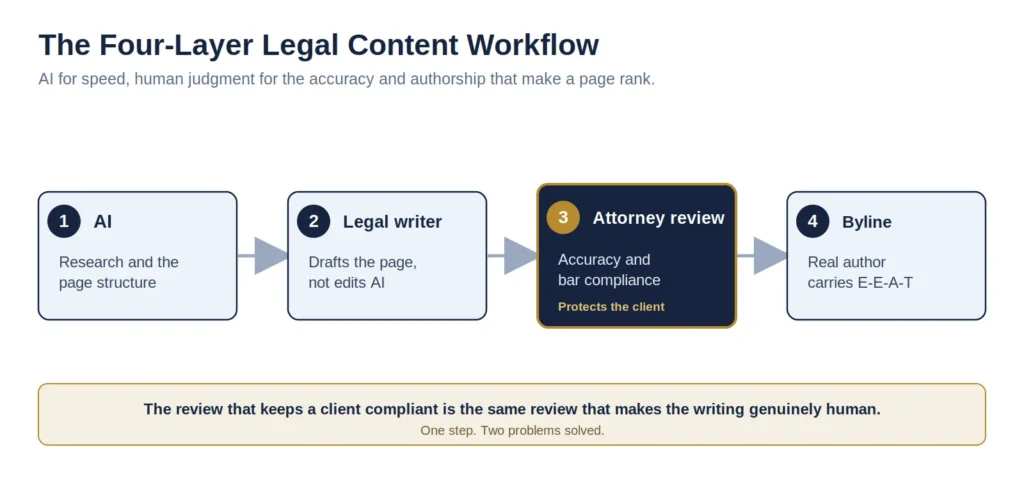
Four-layer legal content workflow: AI research and structure, a legal writer drafting, attorney review for accuracy and bar compliance, and a real byline carrying E-E-A-T

Four layers, in order. AI handles research and structure. A writer with legal background does the actual drafting, not editing of an AI draft, but the writing. An attorney reviews for accuracy and bar compliance. A real byline and attribution carry the E-E-A-T.

The distinction matters more than it sounds. Originality.ai’s own framework treats AI-generated-then-human-edited as still AI, but AI-researched-then-human-written as original human work. That is the line. A Semrush analysis of 42,000 posts found human-written content ranked first about 80% of the time against roughly 9% for pure AI, which tells you where the ranking value actually comes from.

Search Engine Journal made the same point in 2026: agencies pushing more AI output watch rankings stay flat, because the model writes for older search patterns. More volume does not fix it. The human layer does.

Why Attorney Review Is the Step That Protects Your Client

In legal content, the attorney accuracy review you already owe your clients is also what makes the writing genuinely good. Formal Opinion 512 makes the client firm responsible for AI content accuracy, so attorney review is not optional in this niche. It is the deliverable.

That is the part agencies miss. The review that keeps your client out of a bar complaint is the same review that adds jurisdiction-specific fact, real reasoning, and a defensible byline, the things that separate genuinely human work from a draft dressed up to pass a tool. One step. Two problems solved.

Frequently Asked Questions

Does running AI content through a humanizer make it undetectable?

Not reliably, and chasing that is the wrong goal. Detectors flag major humanizer tools at 90 to 97% accuracy, and they also misflag genuine human writing, so no score is guaranteed either way. The durable answer is content a person with legal background actually wrote.

Will Google rank content that AI helped produce?

Yes, when the finished page is genuinely helpful and accurate. Google targets bulk, low-value pages built to game rankings, not the use of AI in the drafting process itself.

Are AI detectors accurate?

Imperfectly. Leading tools claim high accuracy but carry false-positive rates and misflag non-native English writing at high rates. Treat a detector result as one signal, not proof.

Build a Workflow Your Legal Clients Can Trust

At Lexicon Legal Content, we produce white-label legal content for agencies, with attorney review built into every piece, and we are attorney-owned, so the accuracy your clients depend on is handled before delivery, not promised after. No one can promise a detector score, the tools are too unreliable for that. What we can promise is content a person with legal training actually wrote, work that holds up to a bar audit and earns rankings.

If your current process is producing drafts that flag positive or come back for revisions, we can sit underneath your brand and fix the part that breaks retainers. Call 877-486-8123 or reach us through our contact page.

Key Takeaways
1AI handles research and page structure, not the final draft.
2A legal writer drafts the page rather than editing AI output.
3One attorney review covers both accuracy and bar compliance.
4A real author byline carries the E-E-A-T that earns citations.

David Arato, JDs headshot

David Arato, JD is the founder of Lexicon Legal Content, an attorney-owned legal content marketing agency serving law firms since 2012. He has spent more than a decade on both sides of the outsourcing decision, and he advises agencies on where AI belongs in a legal content workflow: fast where it helps, paired with the attorney review that earns rankings and AI citations under YMYL scrutiny, and keeps a client on long-term retainer. David is a frequent contributor to Attorney at Law Magazine and Attorney at Work and a recurring guest on legal marketing podcasts.
An AI Content Strategy for Law Firm Marketing: What to Automate and What to Keep Human

Your firm is already using AI for marketing content, whether you approved it or not. Someone on your team is pasting prompts into a chatbot right now, and at Lexicon Legal Content we hear about it from firms every week. The question is no longer whether to use AI, but where it helps and where it quietly creates risk you will answer for.

An AI content strategy is the plan that draws that line, and for a law firm it is also a bar-compliance plan. We build content with AI under attorney control, and this is how a firm should think about doing the same.

What Is an AI Content Strategy for Law Firm Marketing?

An AI content strategy is a written policy for where AI fits in your marketing content, what it produces, and who signs off before anything publishes. It is the difference between a plan and a free-for-all.

Most firms do not have one. They have associates and vendors using AI tools with no rule about review or accuracy, which is how a wrong statute ends up live under the firm’s name. A strategy sets the rule: what AI touches, what stays human, and how you check the result before it goes out.

A real strategy fits on a page. It names the tasks AI may handle, the tasks it may not, the person who reviews every piece, and the records you keep. Write it down once and you stop having the same argument on every project. You also have an answer if a bar regulator ever asks how your firm uses these tools.

What Should a Firm Automate, and What Should Stay Human?

Automate the early, low-risk work and keep humans in charge of anything that carries legal or reputational weight. AI is fair for brainstorming topics, drafting outlines, producing first drafts, and repurposing one piece into several formats. Speed there costs you nothing.

Keep people in control of legal accuracy, jurisdiction-specific detail, your firm’s voice, the final review, and anything touching client confidentiality. A model does not know your state’s filing deadline or whether a sentence crosses a bar advertising line.

The rule of thumb is simple: AI for the blank page, a person for the parts a reader relies on. A first draft about comparative fault can come from a tool. The sentence that tells a client how fault works in their state cannot, not without a human who knows.

Why AI Strategy and Bar Compliance Are the Same Conversation

For a law firm, an AI content strategy is a compliance strategy, because the ethical duty does not transfer to the tool. The American Bar Association’s Formal Opinion 512, issued in 2024, is direct: a lawyer’s duties under the Model Rules stay with the lawyer when AI is involved.

Three rules carry the weight here. Confirm your strategy answers all three:

  • Competence (Rule 1.1) now includes understanding the tools used on your work.
  • Confidentiality (Rule 1.6) covers anything fed into an AI system, including client facts.
  • Supervision (Rule 5.3) makes you responsible for the vendors and assistants who use AI on your behalf.

Build a review gate into the strategy, or the liability lands on your license. That is the part a chatbot will never warn you about.

Why AI-Only Content Loses in Legal Search

AI-only content loses because legal search rewards exactly what a model cannot fake: accuracy and lived experience. A Semrush analysis of 42,000 posts found human-written content ranks first about 80% of the time, against roughly 9% for purely AI content. The winning formula is AI-assisted and human-finished, not AI-only.

This matters more in law than in most fields. Google treats legal topics as YMYL, “your money or your life,” and AI Overviews now answer most legal queries by citing sources that show real legal knowledge. A page assembled by a model, with no verification and no voice, does not make that cut, no matter how fast it was produced.

So the strategy is not AI versus human. It is AI for speed, humans for the parts that earn trust. A firm that automates the draft and invests the saved hours in review and original detail comes out ahead on both speed and quality. A firm that automates the whole pipeline saves time it later spends on corrections and lost rankings.

How to Measure Whether Your AI Content Strategy Works

Measure quality and outcomes, not output volume. The point of AI is not to publish more. It is to publish better and faster without raising your risk.

Track citations in AI answers, rankings for client-intent queries, and the leads or consultations the content drives. Connect those inquiries to signed cases, because case volume is the only number that funds the firm.

Then watch one safety metric: how much published content actually went through attorney review. If your volume climbs while your review rate drops, the strategy is broken, whatever the dashboard says.

The firms that get this right treat AI the way a good firm treats a sharp paralegal. It does real work, it moves fast, and it never signs off on the final product alone. That is not a limit on AI. It is the structure that lets a firm use it at scale without betting the practice on a guess.

Frequently Asked Questions About AI Content Strategy for Law Firms

Is it safe and ethical for a law firm to use AI for content? 

Yes, with attorney review and accuracy checks built into the process. ABA Formal Opinion 512 keeps the responsibility with the lawyer, so a human has to own the final read.

Will AI-assisted content rank for my firm? 

It can, when a person makes it accurate and genuinely useful. Purely AI content rarely ranks first in legal search; human-finished content does the work.

Who is liable if AI content is wrong? 

The publishing lawyer. Competence, confidentiality, and supervision duties stay with the firm even when a tool or a vendor does the drafting.

What should we automate first? 

Low-risk early work: topic ideas, outlines, and first drafts. Keep legal accuracy, voice, and the final review in human hands.

Build an AI Content Strategy That Protects Your License, With Lexicon Legal Content

AI can make your marketing faster. Handled carelessly, it can also make it a liability. Lexicon Legal Content has been attorney-owned since 2012, more than 13 years, and our leadership holds Juris Doctor degrees: David Arato, JD, and Erin Fitzgerald, Esq., admitted in Missouri and Illinois.

We build content with AI under attorney control, so accuracy and bar compliance are handled before anything reaches you, and every piece is built to be cited in AI search. There is no contract and no minimum. Request a free 500-word sample, call 1-877-486-8123, or reach us through the contact form.


David Arato, JDs headshot

David Arato, JD, is the founder of Lexicon Legal Content, an attorney-owned legal content marketing agency serving law firms since 2012. He advises law firms on where AI belongs in their marketing content and where it does not, building the review gates that keep AI-assisted work accurate and bar-compliant. David is a frequent contributor to Attorney at Law Magazine and Attorney at Work and a recurring guest on legal marketing podcasts.

Humanized AI Content for SEO: What It Takes to Rank in a Legal Niche

Your AI draft took ninety seconds and reads like every other AI draft online. That is the problem. Google does not care that a robot wrote it. It cares that nobody useful did, and at Lexicon Legal Content we built our whole process around closing that gap.

Humanized AI content for SEO is content that starts with AI speed and ends with real human judgment, and in a legal niche that judgment is the whole game. We use AI under attorney control, and the difference shows up in what gets cited. Here is what separates AI content that ranks from AI content that disappears.

What Is Humanized AI Content?

Humanized AI content is material an AI tool drafts and a qualified person then verifies, restructures, and rewrites until it carries real knowledge and a real voice. It is not text run through a “humanizer” button that swaps synonyms to fool a detector.

For legal content, humanizing means a person with legal training checks the law, adds jurisdiction-specific detail, and writes in a voice a reader trusts. The AI handles the blank page. The human handles everything that makes the page worth reading, and worth citing.

The word “humanized” gets misused, so define it carefully. It does not mean a tool that paraphrases AI text to dodge detection. It means a qualified person took ownership of the content and made it true, useful, and specific. One is a costume. The other is the work.

Does Google Penalize AI Content?

No. Google does not penalize content for being AI-generated. It penalizes content for being unhelpful, and plenty of human writing fails that test too.

Google’s own guidance on AI-generated content says quality and usefulness decide rankings, not how the text was produced. The one caveat that matters: using automation to manipulate rankings violates Google’s spam policies.

So the rule is simple. Write to help a reader and AI assistance is fine. Write to game the algorithm at scale and the method does not save you. The penalty was never about the tool.

Why Raw AI Content Fails in a Legal Niche

Raw AI content fails because it cannot do the two things legal search rewards: prove accuracy and prove experience. Law is YMYL, short for “your money or your life,” the category Google holds to the highest accuracy bar because the content affects someone’s finances, freedom, or safety.

An AI model will state a filing deadline with total confidence and get it wrong. A reader facing a real car accident claim acts on that number, misses the real deadline, and loses the case. That is the cost of a confident guess in a legal niche.

The data backs this up. A Semrush analysis of 42,000 posts found human-written content ranks first about 80% of the time, against roughly 9% for purely AI content. AI gets you a draft. It does not get you the citation.

Experience is the harder gap to close. Google’s standard rewards first-hand knowledge, and a model has none. It has never filed a motion, sat across from a frightened client, or watched a judge apply a rule in a way the statute did not predict. The specific detail that proves a human did the work is exactly the detail a reader, and an AI answer engine, rewards.

What Actually Humanizes Legal AI Content

Four moves turn an AI draft into content that ranks and gets cited. None of them is a software trick. Run every draft through these:

  • Verify the law. Check every statute, deadline, and rule against a real source before it publishes.
  • Add what a model cannot know. Jurisdiction-specific detail and experience-based context, the parts an AI only guesses at.
  • Write in a real voice. Cut the hedging and the filler so the page sounds like a person who has done this work.
  • Route it through attorney review. A licensed attorney reads it for accuracy and bar compliance before it ships.

Do those four and you have content built on E-E-A-T, the experience, expertise, authoritativeness, and trust Google rewards. Skip them and you have a fast draft nobody cites, which is the most expensive kind of cheap content there is.

Skip the AI Detectors: Why They Don’t Decide Rankings

Stop chasing a detector score. AI detectors are not a Google ranking signal, and they are unreliable on their own terms. They flag human writing as AI, miss edited AI text, and disagree with each other on the same passage.

A clean detector score proves nothing about whether content is accurate, useful, or citable. A firm could pass every detector and still publish a wrong statute, which is the failure that actually costs you.

Spend the energy on quality instead. The content that wins is the content a reader and an AI answer engine both trust, and no detector measures that.

There is a practical reason this matters for agencies and firms. Time spent reverse-engineering a detector is time not spent verifying the law or sharpening the writing. The first earns you nothing. The second is the entire reason the content ranks.

Frequently Asked Questions About Humanized AI Content

Does humanized AI content rank in Google? 

Yes, when a person makes it accurate, original, and genuinely useful. Google rewards helpful content regardless of how the first draft was produced.

Will AI-assisted legal content get flagged or penalized?

Not for being AI-assisted. Google penalizes unhelpful or manipulative content, not the tool behind it, and AI detectors do not factor into Google’s rankings at all.

Is using AI for legal content ethical and compliant? 

It can be, with attorney review and accuracy checks built in. The responsibility for what publishes stays with the firm, so a human has to own the final read.

Who should review AI-drafted legal content? 

A person with legal background, and for anything client-facing, a licensed attorney. The review is where accuracy and bar compliance actually happen, not in the prompt.

Get AI-Speed Content With Human Judgment, From Lexicon Legal Content

AI can draft fast. It cannot decide what is accurate, and in legal content that decision is everything. Lexicon Legal Content has been attorney-owned since 2012, more than 13 years, and our leadership holds Juris Doctor degrees: David Arato, JD, and Erin Fitzgerald, Esq., admitted in Missouri and Illinois.

We use AI under human and attorney control, so every piece is reviewed for accuracy and built to be cited in AI search, then delivered unbranded for you to resell or publish. There is no contract and no minimum. 

Request a free 500-word sample, call 1-877-486-8123, or reach us through the contact form.


David Arato, JDs headshot

David Arato, JD, is the founder of Lexicon Legal Content, an attorney-owned legal content marketing agency serving law firms since 2012. He has spent more than a decade on both sides of the outsourcing decision, advising the firms that buy legal content and the agencies that resell it under their own brand on what makes white label content rank, earn AI citations under YMYL scrutiny, and keep a client on retainer. David is a frequent contributor to Attorney at Law Magazine and Attorney at Work and a recurring guest on legal marketing podcasts.

EEAT Legal Content: What Law Firms Actually Need to Demonstrate

Legal content sits in Google’s highest-scrutiny category, and most law firms are not treating it that way. We have built content programs for law firms since 2012, and across that work we have watched firms pour budget into pages that rank poorly because they miss the signals Google’s quality raters are trained to evaluate. The framework governing those evaluations is E-E-A-T, and for law firms, it is not optional. 

Lexicon Legal Content is an attorney-founded agency built around the credentials that framework requires.

Why Legal Content Faces a Higher Bar Than Other Industries

Google classifies legal content as YMYL, short for Your Money or Your Life. The classification covers topics that could significantly impact the financial stability, health, or safety of the people reading them. Legal information qualifies directly.

That classification triggers a more demanding quality review. A rater evaluating a recipe page and a rater evaluating a page on criminal defense rights are applying different standards. The recipe page needs to be accurate. The criminal defense page needs to be accurate AND produced by someone who is actually qualified to say it.

This distinction matters because it determines what Google’s raters are looking for before they assign a quality score. If your legal content does not demonstrate the right signals, it does not fail for lack of effort. It fails because the person evaluating it could not confirm that a qualified author produced it.

The Four E-E-A-T Pillars and What They Mean for Law Firms

Experience

Google added Experience to the framework in December 2022. The addition was deliberate. As Elizabeth Tucker wrote in Google’s December 2022 update to the quality rater guidelines: “Does content also demonstrate that it was produced with some degree of experience, such as with actual use of a product, having actually visited a place or communicating what a person experienced?”

For law firms, Experience is the most underused signal in the framework. It does not mean publishing a list of practice areas. It means writing from having actually done the work. An attorney who has represented hundreds of DUI clients can write about what a prosecutor’s offer typically looks like at arraignment. An SEO copywriter cannot. That is the distinction Google is trying to surface.

Framing that works: “In our representation of clients facing federal drug charges, courts in this district typically…” or “Based on outcomes we have seen in similar cases…” Those sentences signal first-hand legal knowledge. They cannot be fabricated without exposure to actual practice.

What does not work: “We have extensive experience handling these cases.” That is an assertion. It demonstrates nothing.

Expertise

The Expertise pillar asks whether the content author is actually qualified to address the legal topic. For law firms, the answer has to be verifiable. A bar admission number, a JD from a named law school, a listed practice area concentration, published legal writing in bar journals or legal publications, these are the signals raters check. “Our attorneys are knowledgeable” is not a signal. A bio that lists bar number, law school, year of admission, and published work is.

Named attorney bylines are not optional. Google’s published content standards ask directly: “Is it self-evident to your visitors who authored your content? Do pages carry a byline, where one might be expected?” For legal content, readers expect one. An unsigned blog post from a law firm carries no Expertise signal because there is no accountable author attached to it.

Authoritativeness

Authoritativeness is the only pillar that lives largely off your website. It refers to whether external sources, other sites, other lawyers, peer-recognition systems, treat you as an authority. Legal directory listings on Avvo, Martindale-Hubbell, Super Lawyers, and comparable platforms carry peer-recognition signals. Media mentions, bar association involvement, backlinks from law school publications, .gov court sites, or state legislature domains, these are the off-site authority signals available to a law firm that a recipe blogger never will be.

Original legal commentary that other attorneys or publishers cite back to is also a strong authority signal. Publishing well-sourced analysis in a bar journal or a legal industry outlet builds the kind of credibility that a general SEO backlink cannot replicate.

Trust

The most important pillar. Google Search Central’s content guidance is explicit: “Of these aspects, trust is most important. The others contribute to trust, but content doesn’t necessarily have to demonstrate all of them.” That sentence belongs in every conversation a legal marketing team has about content strategy.

Trust signals for legal content include: accurate legal information with statute citations linked to primary government sources, attorney-client relationship disclaimers, no-guarantee language on case results, transparent and consistent attorney identity across all pages, verified contact information, HTTPS, and client reviews on third-party platforms the firm cannot control.

Outdated statutes, wrong statutes of limitations, or inaccurate procedural descriptions erode Trust in a way that bad grammar does not. Legal content that is factually wrong is not just a quality failure. For a bar-licensed attorney publishing under their name, it is a professional responsibility concern. That raises the stakes on accuracy to a level no other content category faces.

Where to Start If Your E-E-A-T Signals Are Weak

Trust first. Fix accuracy problems before anything else: verify statute citations against the actual .gov source, add or update disclaimers, confirm that attorney bios and contact information are consistent across the site. None of that requires a content audit or an agency relationship. It requires checking your own pages against primary sources.

Authorship second. Audit your blog archive for unsigned posts and practice area pages without a named attorney author. Retrofit named bylines with full credential information, bar admission state and year, law school, practice area. This alone changes the signal structure of the page.

Experience third. Review your practice area pages for sentences that claim experience versus demonstrate it. Replace assertions with framing that reflects what actually happens in the cases your attorneys handle. This does not require case disclosures. It requires writing from knowledge rather than around it.

Structured data reinforces all of it. Implementing Article schema with a Person type, carrying your attorney’s name, job title, and credential URL, signals E-E-A-T to automated systems in the same way a byline signals it to human raters. Google’s documentation on structured data for author markup confirms that author.url, jobTitle, and honorificPrefix are recognized properties for this purpose.

Frequently Asked Questions About E-E-A-T for Law Firms

Why does Google hold legal content to a higher standard than other websites?

Legal content falls under Google’s YMYL classification, meaning it can significantly affect the financial stability or safety of the people reading it. That triggers stricter quality evaluation focused on author credentials, source accuracy, and verifiable Trust signals.

Do law firm blog posts need a named attorney byline?

Yes. Google’s own guidance asks whether pages carry a byline “where one might be expected.” Readers expect attorney authorship on legal content. An unsigned post carries no Expertise signal and no personal accountability, which damages Trust under the most important E-E-A-T pillar.

What is the difference between E-A-T and E-E-A-T?

Google added a second E for Experience in December 2022, distinguishing between theoretical knowledge and first-hand engagement with a topic. For law firms, it means documenting actual case experience in content, not just listing practice areas. The distinction matters most for practice area pages and blogs.

How do E-E-A-T signals apply differently to AI search?

AI systems evaluating legal content for citation weigh the same credibility signals: named author credentials, primary source citations, accurate legal framing. Law firms that meet YMYL standards also see stronger performance in how AI systems cite legal content, where attributed authorship and source accuracy determine whether a page earns an AI Overview reference.

See Where Your Legal Content Stands

Since 2012, Lexicon Legal Content has produced attorney-reviewed legal content for hundreds of law firms and the agencies that serve them. Every article, blog post, and practice area page goes through JD-trained review before delivery, which means the E-E-A-T signals this article describes are built into our production process, not added as an afterthought. 

Start with our free E-E-A-T assessment, or call us directly at 877-486-8123. You can also contact us online.


David Arato, JDs headshot

David Arato, JD, is the founder of Lexicon Legal Content, an attorney-owned legal content marketing agency serving law firms since 2012. He has spent over a decade inside legal content workflows, watching how law firms lose ground to YMYL scrutiny and what the E-E-A-T signals most content audits miss. David is a frequent contributor to Attorney at Law Magazine and Attorney at Work and a recurring guest on legal marketing podcasts.

Google Doesn’t Penalize AI-Generated Legal Content. Here’s What It Actually Penalizes

AI-generated legal content doesn’t trigger a Google penalty by default. The enforcement mechanism is Google’s scaled content abuse policy, and since March 2024 it applies regardless of how that content was produced. Lexicon Legal Content has tracked every major Google algorithm shift since 2012, and what legal marketing agencies face under this policy is genuinely different from anything that came before.

The Policy Language Most Agencies Are Getting Wrong

Google’s position on AI content has been on the record since February 2023, when the Search Quality team published guidance confirming that appropriate AI use doesn’t violate its guidelines. The prohibited practice is using automation primarily to manipulate rankings. Not using automation itself.

The March 2024 core update added a formal policy category: scaled content abuse. Google’s updated spam policies define it as generating large volumes of content for ranking manipulation without user benefit. The operative clause: the policy applies regardless of how that content was produced.

That last point matters more than anything else in this policy space. It closed the argument that human-reviewed AI content existed outside the prior automated content policy.

Production method isn’t the safe harbor.

The same update folded the Helpful Content System into core ranking. It now appears under retired systems in Google’s ranking systems guide. There’s no isolated helpful content score left to audit separately. Helpfulness is now evaluated at every ranking decision.

Legal Content Has No Margin for Fake Authorship

Legal advice is classified as a Your Money or Your Life topic under Google’s Search Quality Evaluator Guidelines. YMYL content is held to stricter E-E-A-T standards because it can affect a reader’s legal standing, financial decisions, or safety. We covered what that means for law firms in our guide to Google’s AI content policy for law firms. What it means for the agencies producing that content is a different problem.

Trustworthiness is the most consequential of the four E-E-A-T dimensions. Think of an attorney byline as a certificate of service. When an attorney’s name is on a legal filing, they’re representing to the court that they’ve reviewed it and it’s accurate. The same accountability logic applies to practice area content. The byline is a voucher.

When that byline is fabricated, or when a real attorney’s name is on content they’ve never seen, the credibility signal doesn’t just weaken. It inverts.

Google’s quality evaluation framework, as documented in Ahrefs’ E-E-A-T research, uses links and authoritative site mentions as proxies for real-world credibility. For legal content, that chain runs through bar membership, professional reputation, and published legal work. AI-generated content without substantive practitioner involvement has nothing to proxy.

That’s not an AI problem. That’s a fake authorship problem.

A Manual Action and a Core Update Drop Are Not the Same Thing

These are two distinct enforcement mechanisms. Treating them the same delays recovery for client sites and leads agencies to apply the wrong fix.

A manual action is a documented policy violation reviewed by a Google employee. It appears in Search Console under Manual Actions, and the site owner receives notice. Scaled content abuse is a confirmed basis for manual actions. Recovery requires identifying the violation, fixing it, and submitting a reconsideration request.

An algorithmic ranking drop is a reassessment, not a penalty notice. Core updates re-evaluate content quality across the web relative to competing pages. A site with a high proportion of low-value content ranks lower with no Search Console notification and no reconsideration path. Google’s core updates guidance states that recovery requires meaningful site-wide quality improvements and may not be visible until the next update cycle.

A client with a manual action has a defined remediation path. A client whose domain is depressed by core updates has an accumulated quality problem across the entire site. Those aren’t the same problem and they don’t have the same solution.

The Sites That Got Hit Were Not Penalized for Using AI

Google doesn’t publish a penalty registry. What analysis of confirmed scaled content abuse cases establishes is that the distinguishing factor isn’t AI use.

The pattern in confirmed manual action cases, traced through Ahrefs’ penalty case analysis, is deception paired with volume: fabricated author credentials, fake bylines, content published at a pace inconsistent with genuine editorial oversight. For legal content agencies, fake attorney authorship is the specific version of that problem. And it carries professional responsibility implications that go well beyond Google enforcement.

That’s not an AI content penalty. That’s a deception penalty.

A July 2025 Ahrefs analysis of 600,000 top-ranking pages found 86.5% contain AI-generated content, with near-zero correlation between AI percentage and ranking position. A May 2025 Ahrefs study of 900,000 newly crawled pages put that figure at 74.2%. Google can’t and doesn’t suppress AI content categorically. The web crossed that threshold before any enforcement framework could address it.

Where the Actual Exposure Lives for Legal Agencies

Individual site owners face a contained risk set. Legal marketing agencies producing content across multiple law firm clients at volume face compounding exposure in three areas.

Scale relative to editorial review capacity

An agency producing high volumes of AI-assisted content for law firm websites without a documented editorial review process runs the operational pattern the scaled content abuse definition addresses. The question isn’t whether AI was involved. It’s whether production volume was consistent with genuine oversight of legal accuracy and practitioner authorship.

We’ve been producing legal content under attorney review since 2012. We know what a genuine editorial process looks like and what a production conveyor belt looks like. They’re not hard to tell apart.

White-label attribution structure

Content produced under white-label legal content arrangements is published under the client’s brand and shows up in the client’s Search Console account. Any enforcement notice goes to the client. The production decision was the agency’s. That asymmetry is worth examining in your production agreements before you need to.

Domain-level penalty spread

Core updates assess the overall helpfulness of a domain, not individual pages. A law firm domain with a high proportion of low-value content sees ranking depression across the entire site, including the pages that had nothing to do with scaled production. The firm loses organic leads from every practice area.

Recovery requires sustained improvement across the full domain. That’s not a page-level fix.

Three Compliance Variables That Actually Matter

AI use isn’t the compliance variable. Confirmed penalty cases share three factors: scale relative to editorial review capacity, authorship credibility, and content value relative to what already ranks.

Authorship credibility, for legal content, means a real attorney with a valid bar license reviewed the piece before it published and is the named author. Attorney name on the byline without attorney review is the deception signal that converts an algorithmic quality issue into manual action exposure at the YMYL tier.

Content value means what Google’s creating helpful content guidance asks: does the page provide original analysis, jurisdiction-specific legal information, or practitioner insight beyond what already exists on the target query? Accurate statute citations, current case law, and practice-area depth aren’t things AI tools produce reliably without editorial verification. That’s the work the bylined attorney is supposed to be doing.

What meaningful human review of AI-assisted legal content actually requires isn’t a light grammar pass. It’s substantive review of legal accuracy, authorship credibility, and genuine value-add against what already ranks. We’ve required that standard since 2012. It wasn’t a post-March 2024 adjustment for us. It’s how the work has always been structured.

If you’re not sure where a client domain currently stands against these signals, our E-E-A-T Assessment for law firms gives you a clear picture before you spend anything on remediation.

FAQ

Does Google’s scaled content abuse policy treat law firm websites differently from other sites?

The policy applies across all site types, but YMYL classification means law firm sites face stricter E-E-A-T evaluation. A Trustworthiness failure on a legal advice page carries more algorithmic risk than the same failure on a general interest topic because the consequences of bad legal information are real.

What happens to a legal marketing agency when a client site receives a manual action?

Manual action notices go to the affected client’s Search Console account, not the agency’s. Whether the production agreement assigns remediation responsibility to the agency is a commercial question between the parties, not a Google enforcement determination.

What does editorial review actually require for AI-assisted legal content?

A qualified legal editor or the named attorney must verify accuracy, confirm statute citations are current, and review the content before it publishes under their name. Documentation of that review step is the compliance record that supports any good-faith response to a scaled content abuse inquiry.

Does Google use AI detection tools as a direct ranking signal?

Google hasn’t confirmed using any AI detection tool as a direct ranking signal. Its enforcement systems evaluate production patterns, authorship credibility, and content value. None of those evaluations require identifying whether specific AI tools were involved in the content’s creation.

Are legal content pages held to a different standard under Google’s quality evaluation framework?

Yes. YMYL classification means legal content is evaluated under stricter E-E-A-T standards than general web content. A fake or unqualified attorney byline on a practice area page carries substantially more enforcement risk than fabricated authorship on a non-YMYL topic.

Legal Content Built on Attorney Editorial Standards

We’ve been producing legal content under attorney review since 2012 and have watched every major Google algorithm shift from Penguin and Panda to the March 2024 scaled content abuse rollout. 

Attorney byline accountability and YMYL compliance aren’t theoretical risks we’re advising on from the outside. They’re the standards our editorial process was built around from the start. Our work spans more than 300 law firms throughout North America and white-label agency relationships including Rankings.io. Agencies evaluating their current legal content production can request a free consultation through our For Agencies page. 

Call 877-486-8123 or contact us online.


David Arato, JDs headshot

David Arato, JD, is the founder of Lexicon Legal Content, an attorney-owned legal content marketing agency serving law firms since 2012. He has spent over a decade inside legal content workflows, watching how Google’s scaled content abuse policy affects AI-generated legal content in practice and what the agencies producing it most often get wrong. David is a frequent contributor to Attorney at Law Magazine and Attorney at Work and a recurring guest on legal marketing podcasts.

What is AEO for Law Firms? Understanding AI Engine Optimization

Here’s what changed while most law firms weren’t paying attention.

As of early 2026, only 38% of AI Overview citations come from pages ranking in the top 10, down from 76% just one year prior, according to Ahrefs. Your firm can hold the top spot and still be completely absent from the answer AI delivers to a potential client. Around 80% of all searches now end without a click (Similarweb). Traffic from large language models like ChatGPT and Claude climbed 527% last year.

Your law firm’s website? Barely visible in AI answers.

How do you change that? Answer Engine Optimization (AEO).

We’ve been tracking this shift at Lexicon Legal Content, watching how AI search optimization and generative engine optimization are reshaping legal marketing. Law firms are losing ground to aggregator platforms that don’t even create original content. Meanwhile, firms are spending thousands on SEO that doesn’t translate to AI visibility.

For more than a decade, the team at Lexicon has been creating content that increases law firm website visibility. We’ve worked on some of the most successful law firm websites in the country, and our content has ranked nationally for high-volume search terms. Read on to learn more about how we can help get your firm in the AI results.

Overview Summary


Answer Engine Optimization, or AEO, helps law firms earn citations from AI systems like ChatGPT and Google AI Overviews. By delivering precise, expert-reviewed, jurisdiction-specific content, firms increase their visibility, credibility, and client trust in an AI-driven legal search environment.

What is AEO? The Basic Definition

Answer Engine Optimization (AEO), also called GEO (Generative Engine Optimization) or AI search optimization, is getting cited by AI platforms when they generate answers. The industry uses these terms interchangeably, but they all mean the same thing: optimizing content for AI-powered search results.

It’s not about ranking on page one. It’s about being THE answer AI delivers.

The shift: Old search gave 10 blue links. New search gives one AI answer citing maybe two sources.

The platforms: ChatGPT, Perplexity, Claude, Google AI Overviews, Bing Copilot, voice assistants. AI Overviews now appear in approximately 50% of US Google searches (Semrush, early 2026).

The AEO meaning: traditional SEO extends into conversational AI search. Whether called AEO, GEO (Generative Engine Optimization), or AI search optimization, the goal is the same: getting cited by AI engines when they answer user questions. Around 80% of searches end without a click (Similarweb). If you’re not cited, you’re invisible.

Why AEO Matters MORE for Law Firms

Legal content sits in YMYL territory: Your Money or Your Life. AI engines are cautious about legal advice, but that’s your advantage done right.

According to SE Ranking’s YMYL research, 77.67% of legal queries trigger a Google AI Overview, the highest rate of any industry and nearly four times the 21% baseline across all searches. Healthcare triggers AI Overviews 65% of the time. Finance, 42%. Legal leads them all.

The stakes are astronomical. One personal injury case could be worth millions. One corporate client might mean six figures. Missing one query could mean missing a transformative case.

And the clients are already searching. Research by Martindale-Avvo finds that 92.4% of legal consumers are likely or very likely to research their issue before contacting an attorney. That research increasingly happens through AI.

How clients search has changed:

  • “How much does divorce cost in Arizona?”
  • “What should I do after a car accident in Texas?”
  • “Do I need a lawyer to set up my LLC?”

Big firms can outspend you on ads. But they can’t out-answer you. AEO for law firms levels the playing field. Smaller firms with better content win AI citations. Trust signals matter more in legal. People decide who to trust with their case in the AI response, not your website.

How AEO Differs from Traditional SEO

Don’t abandon SEO. Evolve it.

ElementTraditional SEOAnswer Engine Optimization (AEO)
FocusPage rankings, keywords, backlinksDirect answers, clarity, answer-worthy structure
Primary GoalGet clickedGet cited
Content StyleOptimized articlesConversational, question-based content AI can extract
Success MetricsRankings, organic traffic, click-through rateAnswer inclusion, citation frequency, AI visibility
User JourneyUsers click to find informationUsers receive immediate answers

What overlaps? Both need authority signals, quality content, structured data, and E-E-A-T.

The takeaway: solid SEO gets you halfway to AEO. The additional layer asks: “Will AI extract and trust this?”

Strong foundational SEO increases AI citation likelihood, but AI prioritizes credibility and answer clarity over rankings alone.

Why Expert-Reviewed Content Wins in AEO

AI engines scrutinize legal content more heavily than any other industry. They’re looking for expertise markers, not just keywords.

ChatGPT heavily favors established sources. Wikipedia accounts for 27% of all AI citations. Major news outlets and expert-verified content dominate AI search results. Vendor blogs and promotional content are rarely cited, less than 3-4%, and only when demonstrating genuine expertise.

What AI engines check in legal content:

  • Author credentials and verification.
  • Jurisdiction specificity (state-specific guidance beats generic advice).
  • Citations to actual statutes and case law.
  • Neutral, objective tone instead of promotional language.
  • Attorney-reviewed or expert-verified content signals.

Generic content mills can’t provide this accuracy. AI detects vague, promotional language instantly. Expert-reviewed content meets YMYL standards automatically, uses proper legal terminology precisely, and demonstrates genuine expertise beyond SEO tactics.

At Lexicon Legal Content, our legal content marketing experts and attorney-reviewed processes ensure content meets both AI citation standards and compliance with bar advertising rules. That combination, technical SEO knowledge plus legal marketing expertise and legal accuracy, is what makes content citation-worthy.

AEO Works — Here’s the Proof

This isn’t theoretical.

Visitors referred from AI platforms convert at 4.4 times the rate of standard organic visitors, according to Semrush. In B2B professional services, research by Seer Interactive found that ChatGPT referral traffic converts at 15.9%, compared to 1.76% for Google organic. Those visitors arrive pre-qualified: the AI has already vetted your firm as a credible source. That’s a fundamentally different lead than a cold organic click.

Lexicon Legal Content is currently cited in Google AI Overviews for competitive legal industry queries. When someone searches “best legal content company,” Google’s AI system returns our firm as a top recommendation, specifically highlighting our attorney-reviewed content and team of JD-holding writers.m returns our firm as a top recommendation—specifically highlighting our attorney-reviewed content and team of JD-holding writers.

That citation didn’t happen by accident. It’s the direct result of applying the AEO principles outlined in this guide: expert-verified content, clear authority signals, jurisdiction and topic specificity, and content structured for AI extraction.

This is exactly what your firm can achieve. The firms that adapt AEO now won’t just rank better. They’ll be the answers clients receive when they ask AI for legal guidance.

Getting Started with AEO: A Practical Implementation Guide

1. Start with Client Questions

Identify the 10 most common questions clients ask during consultations. Create dedicated pages answering each one clearly, optimizing for both traditional search and AI citations. These questions become your first AEO targets for generative search results.

2. Structure Content for AI

Use conversational language: write like you talk to clients, not court briefs. Put the question as your heading. Give the direct answer in 1-2 sentences, then add supporting details. Keep it concise: a 200-word direct answer beats a 2,000-word article that buries the answer.

“Filing for divorce in Arizona requires…” outperforms “Filing for divorce requires…” because AI can verify jurisdiction and users get applicable information. Include regional specificity in every piece.

3. Add Technical Elements

Implement schema markup for attorney profiles and legal services. Display author bylines with credentials prominently. Use structured data for FAQ sections. Format with clear headers in question format.

4. Focus on Helpfulness Over Promotion

AI rewards genuinely useful content, not keyword-stuffed promotional copy. Before publishing, ask: “Would I cite this as a trustworthy source if I were answering someone’s legal question?” Start with one practice area. Answer 10 key questions well. Monitor what gets cited. Learn what works. Expand from there.

Your 4-Step AEO Strategy

Frequently Asked Questions

Is AEO the same as SEO?

No. SEO optimizes for rankings on search results pages. AEO optimizes to be cited directly in AI-generated answers. Both work together: strong SEO helps AEO, but AEO requires different content strategies focused on direct answers.

Which AI platforms should law firms optimize for?

Focus on ChatGPT, Google AI Overviews, Perplexity, and Gemini. AI Overviews now appear in approximately 50% of US Google searches (Semrush, early 2026). Google AI Overviews appear in 16% of all desktop searches and are growing rapidly.

How long does it take to see AEO results?

Similar to SEO, expect 4-6 months for measurable impact. The timeline depends on your existing content quality, technical optimization, and domain authority. Firms with strong SEO foundations see faster AEO results.

Can AI-generated content help with AEO?

Ironically, no. AI platforms detect AI-written content and deprioritize it, especially for legal topics. Expert-reviewed, human-written content demonstrating genuine expertise consistently outperforms AI-generated material in citations.

What’s the difference between AEO and GEO?

They’re the same thing. AEO (Answer Engine Optimization) and GEO (Generative Engine Optimization) both refer to optimizing content for AI-powered search results. The industry uses both terms interchangeably.

Why do legal queries trigger AI Overviews at a higher rate?

Legal questions affect people’s finances, freedom, and families. Google treats them as YMYL (Your Money or Your Life) queries and applies strict credibility standards. That’s why AI Overviews appear for 77.67% of legal queries, the highest trigger rate of any industry.

Does ranking page one guarantee AI visibility?

No. As of early 2026, only 38% of AI Overview citations come from pages in the top 10 (Ahrefs). Your firm can rank number one and still be absent from the AI answer a potential client reads. SEO and AEO require separate, overlapping strategies.

Do AI-referred visitors convert better?

Yes. Semrush data shows AI-referred visitors convert at 4.4 times the rate of standard organic visitors. They arrive pre-qualified: the AI has already validated your firm as a credible source. That’s a different kind of lead than a cold organic click.

Time to Act on AEO

AEO isn’t the future. It’s happening now.

Every day your firm isn’t optimized for AI search is a day potential clients hear about competitors instead. They’re asking AI for help, and if you’re not in those answers, you don’t exist in their decision.

Most firms haven’t adapted yet. That’s your window.

At Lexicon Legal Content, we’ve been helping law firms stay ahead of digital shifts for over a decade. Our legal content marketing experts understand both how to create content that ranks and how to structure it so AI engines cite it. AEO is the latest evolution in legal marketing, and firms that adapt now gain visibility while competitors figure out what AEO means.

The question isn’t whether to invest in AEO. It’s whether you can afford not to. Call 877-486-8123 or contact us online today to learn how we can help you build content that gets cited and chosen in an AI-first search world.

Key Takeaways


  • AEO focuses on earning AI citations, not just Google rankings
  • Legal queries trigger AI Overviews 77.67% of the time, the highest rate of any industry
  • Only 38% of AI citations come from top-10 ranked pages: page one does not guarantee AI visibility
  • Legal topics require real expertise and accuracy (YMYL)
  • SEO remains important but answer-focused content wins in AI
  • Jurisdiction-specific details increase trust and citations
  • Human, attorney-reviewed content outperforms AI-generated text
  • AI-referred visitors convert at 4.4 times the rate of standard organic visitors
  • Early AEO adoption gives firms a major competitive edge

About the author: David Arato, JD is the founder of Lexicon Legal Content and a legal content marketing expert. For over a decade, he has helped law firms navigate digital marketing shifts by combining technical SEO expertise with deep legal industry knowledge. He is a frequent contributor to various publications, including Attorney at Law Magazine and Attorney at Work and is a frequent podcast guest.