

An agency sends a finished article to a law firm client. The client runs it through Originality.ai. It comes back flagged 94% AI, and the content might have been accurate and well written.
The next retainer call is awkward. That is the real business problem hiding behind the phrase “undetectable AI content.” If you run content operations for legal clients, chasing a detector score is the wrong fix. The goal you actually want is content that holds up as strong, genuinely human work because it was substantively reviewed, verified against the law, and signed by a real author.
That is not a trick. It is the work, and at Lexicon Legal Content we built our agency workflow around exactly that. Here is what it requires.
Use AI for research and page structure, then have a legal writer draft the page and an attorney review it for accuracy and bar compliance.
The same review that catches compliance risk is also what makes the writing genuinely strong, and a real byline gives it the authority that earns citations.
Why “Undetectable” Is the Wrong Target
The instinct is to run AI drafts through a humanizer tool and call it solved. The problem is that detectors now catch those tools too. Originality.ai’s recent model reports detecting popular humanizer output at 90 to 97% accuracy, with several named tools flagged in the low-to-mid 90s.
So the humanizer route is an arms race you lose on a delay. You pay for a tool to beat detection, the detector updates, and your client’s next spot check flags the deliverable anyway. The smarter move is to stop chasing a detector score and put that time into accuracy. For an agency, a flagged deliverable is not a content problem. It is a retainer problem, because client trust does not survive many of those calls.
What Google Actually Penalizes
Not AI. Google’s spam policies penalize scaled content abuse, producing many pages mainly to move rankings instead of helping readers, and the policy applies no matter how the pages were made. AI is not the trigger. Bulk and low value are.
An Ahrefs analysis of 600,000 pages is the clearest read on whether AI content ranks. The correlation between AI percentage and ranking position came in at 0.011, effectively zero, and 86.5% of top-ranking pages contained some AI content. Pure AI rarely takes the top spot, but AI-assisted content is nearly everywhere on page one. You are not hiding that AI touched the draft. You are making the finished page clear the value standard Google measures against.
The Detectors Your Law Firm Clients Are Running
You should know what is scanning your work. Originality.ai markets accuracy above 99% against current models, which sounds final until you read the next number: its lighter model carries a roughly 0.5% false-positive rate, meaning it will sometimes flag genuinely human writing as AI.
That unreliability is documented. The FTC has warned detector vendors not to overstate accuracy, citing a tool whose claimed 98% came in near 53% on general text. A Stanford study reported in Search Engine Journal found detectors misflag more than half of non-native English writing as AI, and have tagged texts like the US Constitution as machine-written. A score is a signal, not a verdict. Building a workflow around beating that signal is building on sand.
The Four-Layer Workflow That Produces Genuinely Human Content
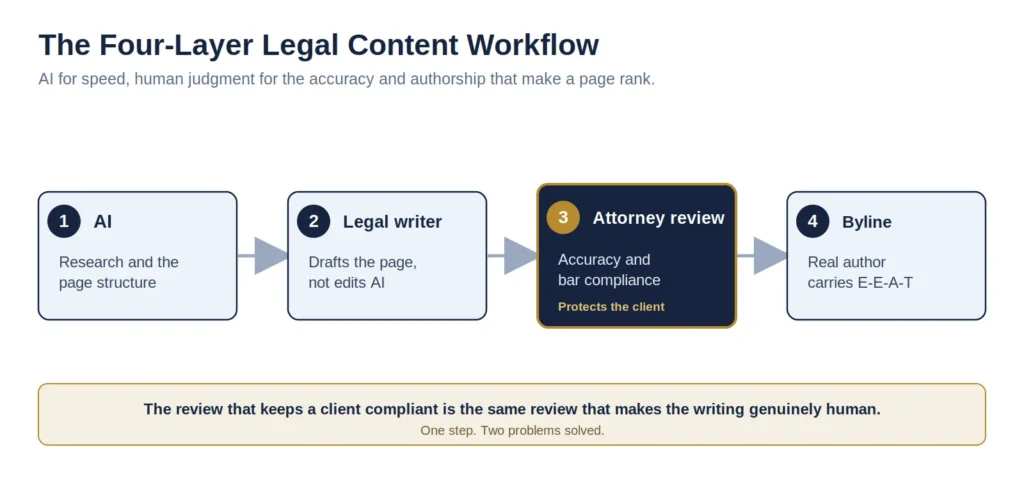
Four layers, in order. AI handles research and structure. A writer with legal background does the actual drafting, not editing of an AI draft, but the writing. An attorney reviews for accuracy and bar compliance. A real byline and attribution carry the E-E-A-T.
The distinction matters more than it sounds. Originality.ai’s own framework treats AI-generated-then-human-edited as still AI, but AI-researched-then-human-written as original human work. That is the line. A Semrush analysis of 42,000 posts found human-written content ranked first about 80% of the time against roughly 9% for pure AI, which tells you where the ranking value actually comes from.
Search Engine Journal made the same point in 2026: agencies pushing more AI output watch rankings stay flat, because the model writes for older search patterns. More volume does not fix it. The human layer does.
Why Attorney Review Is the Step That Protects Your Client
In legal content, the attorney accuracy review you already owe your clients is also what makes the writing genuinely good. Formal Opinion 512 makes the client firm responsible for AI content accuracy, so attorney review is not optional in this niche. It is the deliverable.
That is the part agencies miss. The review that keeps your client out of a bar complaint is the same review that adds jurisdiction-specific fact, real reasoning, and a defensible byline, the things that separate genuinely human work from a draft dressed up to pass a tool. One step. Two problems solved.
Frequently Asked Questions
Does running AI content through a humanizer make it undetectable?
Not reliably, and chasing that is the wrong goal. Detectors flag major humanizer tools at 90 to 97% accuracy, and they also misflag genuine human writing, so no score is guaranteed either way. The durable answer is content a person with legal background actually wrote.
Will Google rank content that AI helped produce?
Yes, when the finished page is genuinely helpful and accurate. Google targets bulk, low-value pages built to game rankings, not the use of AI in the drafting process itself.
Are AI detectors accurate?
Imperfectly. Leading tools claim high accuracy but carry false-positive rates and misflag non-native English writing at high rates. Treat a detector result as one signal, not proof.
Build a Workflow Your Legal Clients Can Trust
At Lexicon Legal Content, we produce white-label legal content for agencies, with attorney review built into every piece, and we are attorney-owned, so the accuracy your clients depend on is handled before delivery, not promised after. No one can promise a detector score, the tools are too unreliable for that. What we can promise is content a person with legal training actually wrote, work that holds up to a bar audit and earns rankings.
If your current process is producing drafts that flag positive or come back for revisions, we can sit underneath your brand and fix the part that breaks retainers. Call 877-486-8123 or reach us through our contact page.

David Arato, JD is the founder of Lexicon Legal Content, an attorney-owned legal content marketing agency serving law firms since 2012. He has spent more than a decade on both sides of the outsourcing decision, and he advises agencies on where AI belongs in a legal content workflow: fast where it helps, paired with the attorney review that earns rankings and AI citations under YMYL scrutiny, and keeps a client on long-term retainer. David is a frequent contributor to Attorney at Law Magazine and Attorney at Work and a recurring guest on legal marketing podcasts.