
- Why Personal Injury AI Optimization Works in Competitive Markets
- The Co-Citation Strategy: Getting Listed Where Competitors Are
- Content Structure That AI Platforms Extract and Cite
- Building Authority Signals AI Platforms Trust
- Monitoring Your Personal Injury AI Optimization Performance
- Common Personal Injury AI Optimization Mistakes
- Frequently Asked Questions
- Getting Started with Personal Injury AI Optimization
Personal injury AI optimization isn’t optional anymore. It’s how firms survive in the most competitive legal market. Personal injury law faces brutal competition, and the rules just changed.
Cost-per-click for “personal injury lawyer” keywords can exceed $1,000 in major markets. Traditional SEO takes 6-12 months to show results. And every competitor is fighting for the same saturated space.

AI search changed the equation. As of February 2026, ChatGPT has 900 million weekly active users. When potential clients ask AI platforms “best personal injury lawyer near me,” only a handful of firms get cited, and the firms that are not among them never enter the conversation.
What’s more, AI visibility is directly affecting traditional Google searches. AI Overviews now appear on a large share of legal searches, and they sit above pay-per-click results, pushing organic results further down the page. In other words, if your PI firm isn’t showing up in the AI Overviews, you’re missing out on the most valuable real estate in the SERPs.
At Lexicon Legal Content, we’ve watched personal injury firms pivot from expensive pay-per-click campaigns to strategic personal injury AI optimization. The firms winning now understand that AI citations generate qualified leads at a fraction of PPC costs.
Here’s how personal injury firms compete in saturated markets through AI optimization.
Overview Summary
Personal injury firms face high competition and costly PPC campaigns. Personal injury AI optimization provides a new path: strategic AI optimization, co-citations, structured content, and authority signals help firms generate qualified leads faster and more efficiently.
Why Personal Injury AI Optimization Works in Competitive Markets
Personal injury law is the perfect test case for AI optimization effectiveness. High competition, expensive advertising, and desperate need for qualified leads make traditional channels unsustainable for most firms.
AI platforms solve a fundamental problem: they pre-qualify leads before anyone clicks. When ChatGPT recommends your firm to someone asking about car accident lawyers, that potential client has already been told you’re trustworthy. Traditional SEO forces you to convince them after they arrive at your site.
A Search Engine Land analysis of nearly 8,000 AI citations found specific patterns personal injury firms can exploit. ChatGPT favors established, authoritative sources like major publications and reference sites. Google AI Overviews pulls from a wider mix including blogs, Reddit, and community forums. Neither platform simply cites the highest-ranking SEO sites. They cite the most helpful, structured, and authoritative sources for each query.
This levels the playing field. A solo practitioner with strategic personal injury AI optimization can outrank firms spending $50,000 monthly on Google Ads.
The Co-Citation Strategy: Getting Listed Where Competitors Are
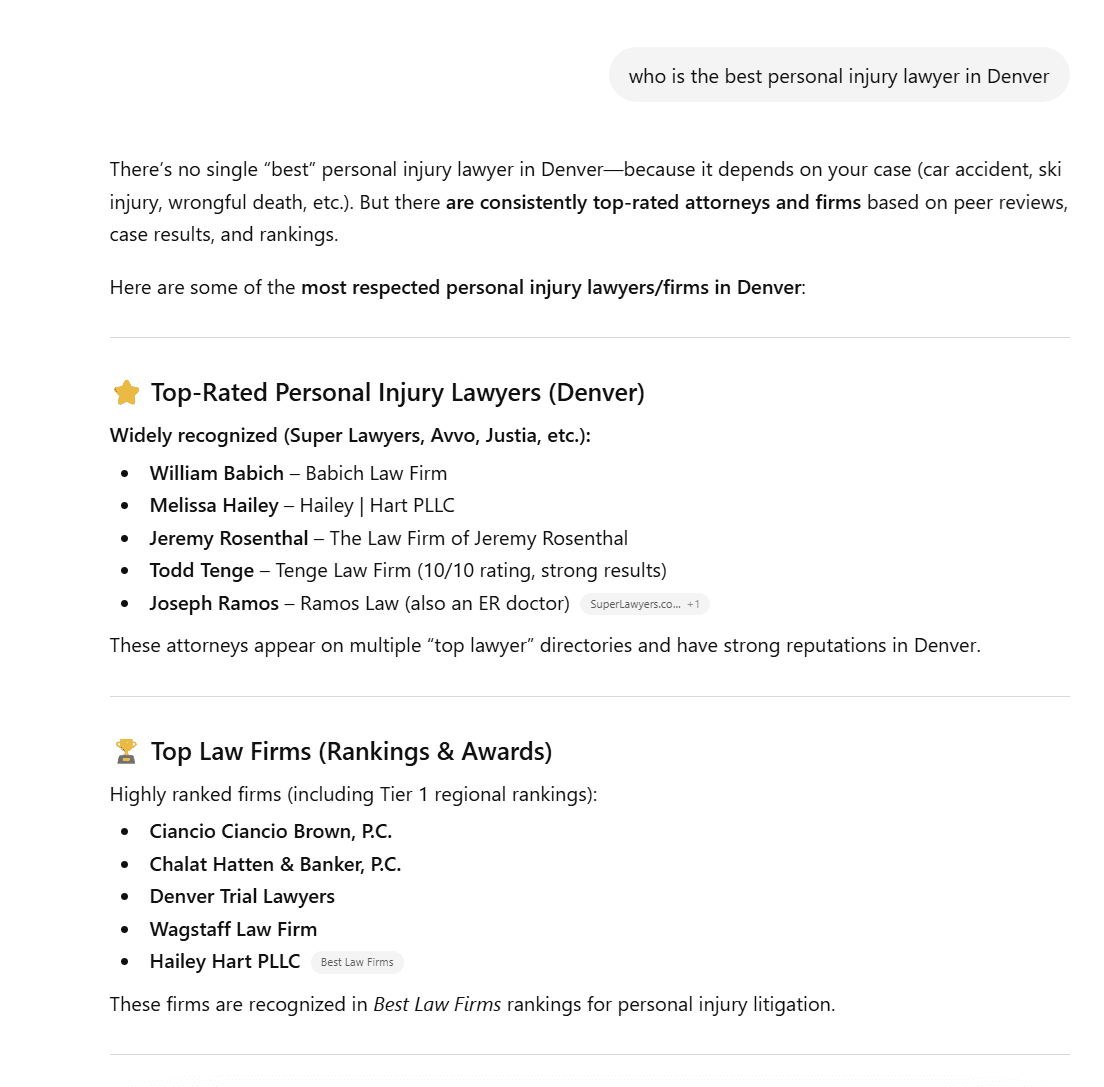
AI platforms heavily rely on lists for recommendations. When someone asks ChatGPT or Perplexity “top personal injury lawyers in [city],” AI answers frequently draw on external lists and directories.
This creates the co-citation opportunity. Get your firm mentioned alongside established competitors on authoritative list-based content.
High-value listing opportunities for personal injury firms:
- Legal directories: Avvo, Justia, Super Lawyers (AI platforms cite these heavily)
- Local “best lawyer” articles in newspapers and city magazines
- Industry roundups: “Top Personal Injury Firms in [State]”
- Review platforms where competitors are listed (Yelp, Google Reviews aggregated in articles)
- Reddit discussions in r/legaladvice and city-specific subreddits
Reddit is increasingly cited in ChatGPT answers, which makes it worth attention for personal injury firms. When someone asks “personal injury lawyer recommendations [city]” on Reddit, authentic responses create training data AI platforms use.
Action step: Find 20 list-based articles that cite your top 3 competitors. Get your firm added to those same lists through outreach, guest posts, or by creating your own superior list content.
Content Structure That AI Platforms Extract and Cite
AI platforms don’t rank pages — they extract answers. The difference matters for how you structure every piece of content on your PI firm’s website.
The content structure that consistently gets cited follows a simple pattern: lead with the direct answer, support it with jurisdiction-specific detail, and close with related questions in FAQ format with schema markup.
Here’s what that looks like in practice. A page targeting “how long do I have to file a personal injury claim in Texas” should open with this:
“In Texas, you have two years from the date of injury to file most personal injury claims under Texas Civil Practice & Remedies Code § 16.003. Missing this deadline permanently bars your right to compensation in most cases.”
That first paragraph is what ChatGPT and Google AI Overviews extract and cite. Everything that follows – exceptions for minors, the discovery rule, what happens if you miss the deadline – demonstrates expertise and earns trust, but the citation happens in the first two sentences.
Most PI firm content buries the answer in paragraph four. That’s why competitors get cited and you don’t.
Building Authority Signals AI Platforms Trust
Personal injury law is YMYL (Your Money or Your Life) content. AI platforms apply stricter standards when recommending legal services.
Essential authority signals:
- Attorney credentials prominently displayed – Bar admissions, years of experience, case results
- Schema markup for attorneys and practice areas – LegalService and Person schema tell AI exactly what you offer
- Case results and testimonials – Real outcomes build credibility (follow bar advertising rules)
- Citations to actual statutes and case law – Shows you’re not just marketing, you’re actually practicing law
- Locally-specific content – “California Vehicle Code Section 17158” beats generic “car accident law”
YMYL sites show 68-75% overlap between AI citations and traditional rankings. Strong SEO foundation directly feeds AI visibility for personal injury content.
Monitoring Your Personal Injury AI Optimization Performance
You can’t improve what you don’t measure. Track AI visibility across platforms:
Manual monitoring:
- Ask ChatGPT: “Best personal injury lawyer in [your city]”
- Check Perplexity for: “[injury type] attorney recommendations [location]”
- Test Google AI Overviews for your target keywords
- Monitor your practice areas weekly
Tracking tools:
- Semrush AI SEO Toolkit tracks ChatGPT, AI Mode, and AI Overview visibility
- Otterly.ai pulls citations across multiple AI platforms
- Position Tracking with ChatGPT engine selected
Document which content gets cited and by which platforms. Double down on what works.
Common Personal Injury AI Optimization Mistakes
Avoid these pitfalls we see constantly:
Mistake #1: Focusing only on Google SEO
AI platforms use different ranking signals. Reddit mentions and list citations matter more than backlinks.
Mistake #2: Generic content
“Personal Injury Law 101” won’t get cited. “Ohio Revised Code § 2305.10 Statute of Limitations for Car Accidents” will.
Mistake #3: Ignoring local specificity
AI platforms favor jurisdiction-specific answers. State, county, and city-level legal information beats generic advice.
Mistake #4: No schema markup
Structured data gives an engine a cleaner read of your practice areas, though it isn’t a condition of being cited.
Mistake #5: Thin FAQ sections
Three generic FAQs won’t cut it. Build comprehensive FAQ pages with 20+ answered questions and proper FAQPage schema.
Frequently Asked Questions
How is personal injury AI search optimization different from traditional SEO?
AI search optimization prioritizes being cited in answers, not ranking in results. Focus on co-citations (appearing alongside competitors in lists), Reddit presence, and question-answer content structure. Traditional SEO focuses on backlinks and keyword rankings, both still matter but aren’t sufficient for AI visibility.
What’s the fastest way to improve personal injury AI citations?
Implement LegalService and Person schema markup, then create 10 jurisdiction-specific FAQ pages with proper schema. Get listed on directories where AI platforms find competitors. These foundational steps show results in 30-60 days versus 6-12 months for traditional SEO.
Do personal injury firms need to be on Reddit for AI optimization?
Reddit is increasingly cited in ChatGPT answers. However, engagement must be ethical and valuable, never solicit clients directly. Provide genuinely helpful legal information, build authority, and let your expertise speak. Bar rules always apply.
Can small personal injury firms compete with large firms using AI optimization?
Yes, this is AI optimization’s biggest advantage. AI platforms don’t prioritize website authority or ad spend. They cite the most helpful, structured, authoritative answers. A solo practitioner with strategic content outranks firms spending six figures monthly on advertising.
Getting Started with Personal Injury AI Optimization
Personal injury AI optimization compounds over time. Start with high-impact fundamentals:
- Audit current AI visibility – Where does your firm appear now?
- Implement attorney and practice area schema – How AI search engines read a law firm site
- Create 10 question-based content pages – Target your most valuable case types
- Get listed alongside top competitors – Find their citations, join those lists
- Monitor and iterate monthly – Track what gets cited, do more of it
The firms dominating personal injury AI optimization in 2026 are building foundations today.
Need help with personal injury AI optimization strategy? Call Lexicon Legal Content at 877-486-8123 or contact us online. We’ve been optimizing legal content for over 13 years, from traditional SEO through today’s AI-driven discovery.

David Arato, JD, is the founder of Lexicon Legal Content, an attorney-owned legal content marketing agency serving law firms since 2012. For over a decade, he has helped personal injury firms and other practices structure and optimize their web presence for search visibility. He now focuses specifically on how content architecture, schema markup, and AI optimization strategy determine whether platforms like ChatGPT, Google AI Overviews, and Perplexity cite your firm – or your competitor’s. He is a frequent contributor to Attorney at Work and Attorney at Law Magazine, and a regular guest on legal marketing podcasts.