

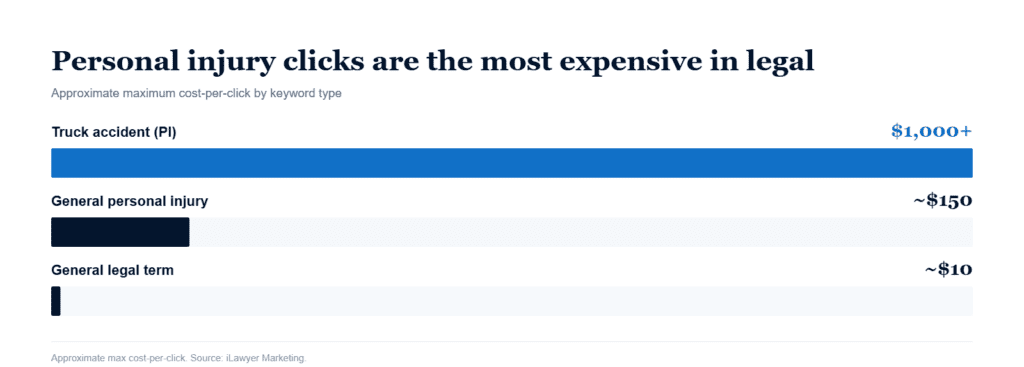
Personal injury is the single most competitive and expensive niche in legal search, and PI SEO is less about doing more and more about doing the handful of things that actually sign cases. Some personal injury keywords, truck accident terms especially, run over $1,000 per click, according to iLawyer Marketing.
At Lexicon Legal Content, we work with personal injury firms that have already burned through ad budgets chasing volume instead of the local, high-intent signals search engines actually reward. This guide covers what ranks, what it costs, and how to feature real case results without triggering a bar complaint, a gap every other PI SEO guide online leaves wide open. It is a gap worth closing before a competitor’s marketing team closes it first.
Personal injury SEO ranks locally, costs more than any other legal niche, and only works long-term when case results are featured with the bar-required disclaimer attached.
This guide breaks down what to build, what to budget, and how to stay compliant while you do it.
What Actually Ranks in Personal Injury SEO
PI rankings are won locally: an optimized Google Business Profile, geo-specific practice pages, and content that answers the exact questions an injured person types in the first hours after a crash. According to SOCi’s Consumer Behavior Index, about 80% of consumers search for local businesses weekly, and injury clients search from a phone within minutes of a wreck, not days later. Backlinko’s 4-million-result CTR study found the top three organic positions capture 54.4% of all clicks, and a firm that lands its Google Business Profile in the local pack wins that same early real estate before a standard organic listing even gets seen.
That means a firm without a fully optimized Google Business Profile is competing for less than half the available clicks before the organic results even load. Geo-specific pages, a “truck accident lawyer in [city]” page instead of one generic practice page, combined with content built around the exact question an injured person is typing, turn that local visibility into a call.
Google’s own AI Overview for personal injury SEO queries confirms this pattern. It directs searchers toward hyper-local optimization, geo-specific keywords, and content built around what an injured client actually asks in the first hours, not generic legal explainers written for search engines instead of people.
This is where most PI marketing money gets wasted. Firms pour budget into a single national practice area page and a handful of long-form guides while a competitor building a geo-specific personal injury content strategy quietly takes the rankings in the neighborhoods that actually send referrals. Volume of content was never the variable that mattered. Specificity to a location and a real client question was.
What It Really Costs and How Long It Takes
PI keywords are the priciest in all of legal, with some clicks running over $1,000, and Ahrefs data shows fewer than 2% of new pages reach the top ten within a year, so PI SEO is a compounding investment, not a quick win. iLawyer Marketing puts the cost of a single truck accident click above $1,000, the highest cost per click of any legal practice area. Ahrefs’ 2025 study of ranking pages found only 1.74% of new pages reach page one within their first year, regardless of niche.
Cost varies within PI itself. Catastrophic injury and trucking cases sit at the top of that range, while smaller car accident terms run lower but still cost more than the average general legal keyword. Personal injury, with its established competitors and high keyword difficulty, sits at the harder end of that ranking curve.
The realistic timeline is months of geo and content work before rankings move, not weeks. Firms that budget for that runway, and measure signed cases rather than raw traffic, are the ones still ranking two years later. The ones chasing a fast win usually pull the plug before the compounding effect shows up, which hands the ranking they almost earned to whichever competitor stayed the course.
Featuring Results Without Breaking Bar Rules
The riskiest PI SEO advice online tells firms to headline their biggest settlements, but ABA Model Rule 7.1 bars any claim that implies a guaranteed or predictable outcome, and most states require a prior-results disclaimer whenever a verdict or settlement figure appears on a website. That is not a marketing detail. That is a professional liability problem with the firm’s name attached to it.
Comment 3 to Rule 7.1 addresses past results directly: a truthful statement about a prior verdict is not inherently misleading, but it becomes misleading if it implies a similar result is likely for a future client without disclosure. States including Florida and New York go further than the model rule and require specific disclaimer language near any results claim, so the correct wording depends on where the firm is licensed.
Feature the number with the disclaimer instead of avoiding results altogether. That distinction is what separates a case results page that converts from one that draws a bar grievance, and none of the highest-ranking PI SEO guides we reviewed for this piece mention it at all.
That silence is the opportunity. A firm that ranks locally, publishes results the compliant way, and can point to both when a prospect is comparing three law firm websites at once wins the comparison on trust as much as on rank.
FAQ
How long does PI SEO take to work?
Ahrefs data shows only 1.74% of new pages reach page one within a year across all niches, and personal injury sits at the harder end of that curve given its competition. Budget for a compounding, multi-month runway rather than a fast win.
Can I put my settlement results on my website?
Yes, with the required disclaimer. ABA Rule 7.1 and most state bar rules allow truthful past-results statements as long as the page discloses that results vary and past outcomes do not guarantee future ones.
What is YMYL and why does it matter for personal injury content?
YMYL stands for Your Money or Your Life, Google’s label for content that can affect health, finances, or safety. Personal injury falls squarely into that category, so quality raters hold it to the strictest E-E-A-T standard in legal search.
Does the Rule 7.1 disclaimer requirement apply outside a dedicated results page?
Yes. The disclaimer requirement follows a settlement or verdict figure everywhere it appears, including blog posts and social media, not just a dedicated results page. State bar rules apply the same standard regardless of where it is published.
Get Personal Injury Content Built to Rank and Stay Compliant
Personal injury SEO rewards firms that pair local, high-intent content with case results handled the right way.
At Lexicon Legal Content, we have built attorney-reviewed, bar-compliance-aware content for law firms since 2012, including the kind of results pages this guide describes. Call 877-486-8123 or request a free content sample to see how a PI-specific strategy would look for your firm.

David Arato, JD, is the founder of Lexicon Legal Content, an attorney-owned legal content marketing agency serving law firms since 2012. He has spent years watching personal injury firms lose ground to compliance mistakes their SEO guides never warned them about, and has built Lexicon’s process to catch what generic marketing playbooks miss. David is a frequent contributor to Attorney at Law Magazine and Attorney at Work and a recurring guest on legal marketing podcasts.