

- What SEO Marketing for Attorneys Actually Means in 2026
- How AI Search Is Changing Attorney SEO Right Now
- GEO for Attorneys: The Missing Half of Your SEO Strategy
- Why Local SEO Still Drives the First Call for Most Law Firms
- Why Most Law Firm SEO Content Fails in AI Search
- How to Build an SEO and GEO Strategy for Your Law Firm
- Why Attorney SEO in 2026 Rewards Early Movers
SEO marketing for attorneys has changed more in the past two years than in the previous ten combined.
The shift is not incremental. Nearly 78 percent of legal queries now trigger an AI overview, with Semrush data showing organic click-through rates dropping by more than half when AI answers appear at the top of results. Ranking on page one used to be the goal. Now, page one itself is shrinking.
At Lexicon Legal Content, we have been creating SEO-focused content since 2012. We watched the mobile shift. We watched voice search come and mostly go. This one is different.
This article breaks down what still works, what has changed, and what your firm should be doing right now to stay visible when clients are looking for legal help.
What SEO Marketing for Attorneys Actually Means in 2026
A quick note on who we are and what we do: Lexicon Legal Content is a legal content marketing firm, not a full-service SEO agency. We do not run ad campaigns or handle the technical backend of your website. What we do is produce the attorney-attributed, jurisdiction-specific, AI-ready content and schema markup that makes your broader SEO investment actually work, and we can help you think through the full strategy even when execution sits elsewhere. We cover this topic because content is the engine behind both traditional SEO and GEO visibility, and law firms need to understand the full landscape to make smart decisions about where to invest. If you need a full-service SEO agency, we can point you toward good ones. If you need content that earns citations, ranks, and converts, that is what we do.
SEO marketing for attorneys in 2026 means building simultaneous visibility in both traditional search rankings and AI-powered answer platforms like Google AI Overviews, ChatGPT, and Perplexity.
Law firm SEO used to mean one thing: rank on page one for your most important keywords and let your website do the rest. That model worked because the search results page was the destination. Clients clicked, read, and called.
That’s no longer how it works.
The search results page has become a starting point for AI-generated answers, not a directory of links to explore. Ranking on page one still matters, but it no longer guarantees visibility. A firm can hold a first-page position for a high-value keyword and still be completely absent from the AI-generated answer a potential client reads and acts on.
What SEO marketing for attorneys means in 2026 is building visibility across two systems simultaneously. The first is traditional search, where Google evaluates your site’s authority, relevance, and technical health. The second is AI search, where platforms like ChatGPT and Google AI Overviews evaluate your content’s depth, accuracy, and trustworthiness before deciding whether to cite it. These systems overlap but they are not the same, and optimizing for one while ignoring the other is how firms end up with strong rankings and shrinking lead flow.
How AI Search Is Changing Attorney SEO Right Now
This shift isn’t speculation. According to Semrush’s 2025 study of more than 10 million keywords, AI Overviews appeared on roughly 13 to 16 percent of all search queries through 2025, peaking near 25 percent mid-year.
For legal searches specifically, that figure is far higher – nearly 78 perecnt.
What does that mean in practice? It means a potential client searching for “What should I do after a car accident?” or “How do I file for divorce?” is now getting a full answer directly on the search results page, often without clicking a single link. Similarweb’s 2025 data shows that zero-click searches on Google grew from 56 percent to 69 percent in a single year. That means nearly 7 out of every 10 searches now end without anyone clicking through to a website. AI Overviews are a major driver of that jump.
Importantly, Google is now adding citations to the AI overview results showing where the surfaced inforation comes from – and they are clickable. In the screenshot below, you’ll the see the results of a search for “what to look for in a car accident lawyer in Las Vegas.” The AI Overview is at the top of the page, and the user can see which law firms are being cited. If the user hovers over the citation, a popup appears that allows the user to navigate to the page:
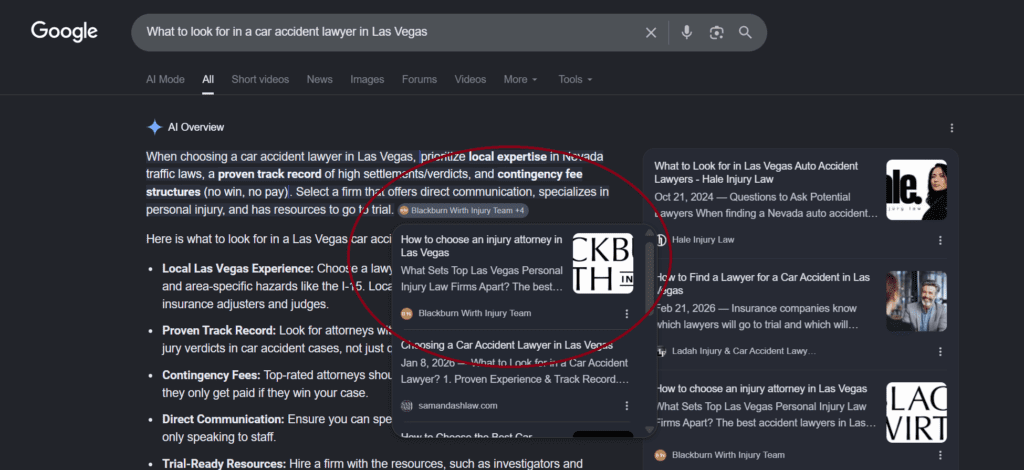
The result? Position one isn’t even visible without scrolling down. In other words, AI overviews are the new “position one.”
Gartner projected a 25 percent decline in traditional search volume by 2026 – a shift that is already materializing. And this isn’t limited to Google. ChatGPT, Perplexity, and other AI assistants are becoming the first place people go when they have a legal question. Someone who might have typed “personal injury lawyer near me” into Google two years ago is now asking an AI assistant “What should I do if I got hurt at work?” and getting a full response that names specific firms, cites specific laws, and gives step-by-step guidance.
AI search visibility for attorneys is no longer a nice-to-have. If your firm isn’t part of the answer the AI generates, you’re invisible during the most important part of the client’s decision-making process. They may never see your website, your reviews, or your phone number because they already got what they needed from the AI. And the data backs this up: early research suggests that traffic referred by AI platforms, while still a small share of the total, converts at significantly higher rates than traditional organic traffic, because those users arrive with more context and higher intent.
Ranking on page one used to be the goal. Now, page one itself is shrinking.
GEO for Attorneys: The Missing Half of Your SEO Strategy
“GEO” stands for Generative Engine Optimization. In plain terms, it’s the practice of structuring your firm’s content so that AI platforms cite your website when generating answers to legal questions. Traditional SEO gets you listed in search results. GEO for law firms gets you mentioned inside the answer itself.
That distinction matters more than most attorneys realize. When someone asks ChatGPT about personal injury deadlines in their state, the AI pulls information from sources it considers authoritative and well-structured. If your firm’s website has a clear, accurate, well-organized page on that topic with proper legal citations and attorney attribution, you have a chance of being cited. If your content is thin, generic, or missing those signals, you won’t be.
AI platforms tend to reward three things when deciding what to cite. First, attorney-written or attorney-reviewed content that demonstrates real legal knowledge, not surface-level summaries that anyone could write. Second, proper schema markup, the technical code behind your pages that helps AI systems understand who you are, what you practice, and where you’re located. Third, jurisdiction-specific detail. A page about “personal injury law” loses to a page about “personal injury claims under California Civil Code Section 1714” every time in AI search results.
It comes down to trust and E-E-A-T signals. If your content doesn’t demonstrate those signals clearly, it won’t be recommended to your potential clients. And trust, in this context, is built on depth, accuracy, attribution, and structure. Not word count, not publishing frequency, and definitely not generic blog posts written to hit a keyword quota.
Why Local SEO Still Drives the First Call for Most Law Firms
GEO gets a lot of attention right now, and it should. But for the majority of law firm clients — people searching for a personal injury attorney after a car accident, a criminal defense lawyer after an arrest, a family law attorney during a divorce — the decision process still runs through local search before it reaches AI-generated answers.
Local SEO for attorneys means making sure your firm shows up when someone in your city searches for help. That requires three things working together: a fully optimized Google Business Profile, consistent NAP citations across directories, and location-specific pages on your website that go beyond just naming the city.
Your Google Business Profile is still the highest-leverage local SEO asset most firms underuse. A complete profile with current hours, accurate practice area categories, a populated Q&A section, and a steady flow of recent client reviews outperforms an incomplete profile in the local pack regardless of how strong the rest of your SEO is. If your profile hasn’t been audited in the past six months, that is where to start.
Location pages work when they contain real, jurisdiction-specific content — the local courthouse, the county’s specific procedural rules, the judges or court divisions that handle your case type. A page that says “We serve clients in Denver and the surrounding area” is not a location page. A page that explains how the Denver District Court handles felony arraignments, or what the Jefferson County courts require for divorce filings, is.
Local SEO and GEO are not in competition. A strong local SEO foundation — a trusted domain, consistent citations, attorney-attributed content — is the same foundation that makes your content credible to AI systems. Build it once. It works across both channels.
Why Most Law Firm SEO Content Fails in AI Search
Most firms don’t want to hear this, but the content on your website is probably not good enough for GEO. We say this to clients regularly, not to be harsh, but because it’s the reality of how AI search actually evaluates legal content.
Most law firm websites are filled with practice area pages that read like they were written by someone who Googled the topic for 20 minutes.
They’re generic, they’re shallow, and they could describe any firm in any state. AI platforms can spot this. When a model is deciding which sources to cite in a response about, say, wrongful termination in Texas, it’s not going to pick a 300-word page that says “wrongful termination is when you’re fired illegally.” It’s going to pick the page that cites the specific statute, explains how Texas courts have interpreted it, and carries a real attorney’s name.
AI-generated content makes this problem worse, not better. We’ve watched firms publish dozens of blog posts produced by ChatGPT with minimal review, and the results are predictable. Those posts may contain technically accurate information, but they lack the depth, jurisdiction-specific detail, and professional perspective that AI search engines look for when choosing what to cite. Using AI to mass-produce your content makes you invisible to AI-powered search. That’s not irony. It’s just how the system works.
Legal content marketing in 2026 requires content that is genuinely written or thoroughly reviewed by a practicing attorney, carries proper attribution, and demonstrates the kind of legal depth that both a potential client and an AI model can trust. Firms that treat content as a checkbox instead of a strategic asset are losing ground every month. The gap between firms with strong, attorney-backed content and firms with generic pages is only going to widen as AI becomes a bigger part of how clients find legal help.
The approach works. Lexicon’s own content on AI Overview optimization ranks #2 organically for “AIO for lawyers” and appears as a cited source inside Google’s AI Overview for that query — the same result we help law firms achieve. If it works for a legal content agency competing in a crowded SEO space, it works for a law firm with the right content foundation in place.
Firms that pair traditional SEO with GEO-optimized FAQ content start appearing as cited sources in AI Overviews faster than pages that don’t use structured, direct-answer content. How fast depends on query competitiveness, but the pattern is consistent: structured answers get pulled, long hedged paragraphs don’t.
Not sure where your firm’s content stands? We audit law firm content and GEO readiness. Call 877-486-8123 or contact us online to get started.
How to Build an SEO and GEO Strategy for Your Law Firm
SEO and GEO are not competing strategies, and any effective law firm content marketing strategy treats them as sequential. One builds on the other, and firms that treat them as separate initiatives are wasting time and money.
Start With Your Technical SEO Foundation
Traditional SEO builds your domain authority and makes sure search engines can find and index your pages. GEO builds your citability and makes sure AI platforms trust your content enough to recommend it. You need both, but the order matters. If your technical SEO is broken, your site speed is poor, or your local citations are inconsistent, fix those first. AI platforms draw heavily from the same signals Google uses, so a site with strong SEO fundamentals is already halfway to GEO readiness.
Layer In GEO-Specific Content Work
Once the foundation is solid, start layering in GEO-specific work. That means implementing schema markup, specifically LocalBusiness, LegalService, FAQPage, and Attorney schema at minimum, so AI systems can parse your firm’s information cleanly. FAQ sections need to directly answer the questions your potential clients are asking AI assistants — not vague summaries, but specific answers to specific questions. And it means making sure every substantive page credits a named attorney with verifiable credentials.
Getting your firm into AI answers requires four concrete actions on every substantive page. First, audit existing pages for attorney attribution gaps — any page without a named attorney tied to it is invisible to AI credibility filters. Second, add FAQPage schema to every practice area page; without it, your FAQ answers are not structured for AI extraction. Third, rewrite thin pages to include state-specific statute citations and jurisdiction detail. Fourth, confirm that every page carries a named attorney’s credentials in a visible author block, not just a generic “our team” reference.
What an AI-Ready Law Firm Page Actually Looks Like
Consider the difference. A firm with a page titled “Car Accident Lawyer” that lists general services and ends with a phone number is doing the minimum. A firm with a page that breaks down the state’s specific statute of limitations, explains comparative fault rules with citations to actual code sections, includes an FAQ section answering questions people ask AI assistants, and carries the name of the attorney who handles these cases is doing GEO. Both pages may rank on Google. Only one is likely to be cited by ChatGPT.
The content audit process we use at Lexicon typically starts with a few straightforward questions about your existing content. Is this page detailed enough that an AI system would trust it as a source? Does it cite real statutes and legal standards? Is an attorney’s name attached? Is the information specific to a jurisdiction, or could it describe any firm anywhere? If the answer to any of those is no, the page needs work before it can earn AI citations.
Early research from Ahrefs has found that only about 12 percent of URLs cited by platforms like ChatGPT and Perplexity also rank in Google’s top 10. That tells you something important: the sources AI models choose to cite don’t always match what Google ranks highest. SEO for attorneys gets you into the index. GEO gets you into the answer. The firms doing both are the ones pulling ahead.
Frequently Asked Questions: SEO Marketing for Attorneys
Is SEO still worth investing in for law firms in 2026?
Yes, but the return on that investment depends on whether your SEO strategy has kept pace with how clients now search for legal help. Traditional SEO, meaning keyword optimization, local citations, and technical site health, remains the foundation. Without it, nothing else works. But firms that stop at traditional SEO are missing the growing share of potential clients who find attorneys through AI-powered tools like ChatGPT and Google AI Overviews. SEO gets you into the index. You need more to get into the answer.
How long does SEO marketing take to produce results for a law firm?
Most law firms start seeing measurable traction from SEO within 3 to 6 months. AI Overview citation pickup can happen faster for pages with well-structured FAQ content and clear direct answers — though competitive queries can take longer.
What type of content performs best in attorney SEO?
Content that is specific, accurate, and demonstrably written or reviewed by a practicing attorney consistently outperforms generic practice area pages. This means jurisdiction-specific information, citations to actual statutes and case law where relevant, FAQ sections that answer questions people ask AI assistants, and clear attorney attribution on every substantive page. Word count matters less than depth and credibility.
What is the difference between SEO and GEO for law firms?
SEO, or search engine optimization, focuses on ranking your firm’s pages in traditional search results. GEO, or generative engine optimization, focuses on getting your firm’s content cited by AI platforms like ChatGPT, Perplexity, and Google AI Overviews when they generate answers to legal questions. The two strategies share the same foundation but require different content approaches. A firm doing only SEO is optimizing for a search landscape that is shrinking. A firm doing both is positioned for where legal search is heading.
How much should a law firm budget for SEO marketing?
Budgets vary significantly based on market size, practice area competition, and how much foundational work needs to be done. Small firms in less competitive markets might see results with a monthly investment in the low thousands. Firms competing for high-value keywords in major metro areas typically spend considerably more. The more relevant question is whether your current investment is producing content that meets the quality bar AI search now requires, because spending money on generic content delivers diminishing returns regardless of the budget size.
How do I check if my firm is already showing up in AI Overviews?
Search your target practice area queries in Google from a private browsing window and check whether an AI Overview appears at the top. If it does, check whether your firm is cited. You can also test in ChatGPT and Perplexity by asking “who are the best [practice area] attorneys in [city].” Tools like Semrush’s AI Visibility feature can automate this tracking across multiple keywords.
Does this work differently for solo attorneys versus large firms?
The strategy is the same — attorney attribution, FAQ schema, jurisdiction-specific content, and GBP optimization. The timeline and scope differ. Solo attorneys can often move faster because there are fewer pages to audit and optimize. Large firms need a systematic approach across dozens or hundreds of practice area pages. We work with both.
Why Attorney SEO in 2026 Rewards Early Movers
AI-powered search is not a future trend. It’s the current reality, and the firms positioning themselves now are building advantages that compound over time. The longer you wait, the harder it becomes to close the gap, because your competitors are already earning the citations and authority signals that AI platforms remember. This isn’t like a Google algorithm update where everyone resets at the same time. In AI search, early movers build lasting authority that’s difficult to displace.
At Lexicon, SEO focused content is what we do, and we’ve built our entire process around what search looks like today.
Every piece of content we produce is reviewed by JD-trained legal writers who understand both the legal substance and the technical requirements that make content visible to AI platforms. If you want your firm showing up in AI answers — not just Google rankings — call 877-486-8123 or contact us online. Every engagement starts with a content audit. No obligation. We will show you exactly where your current content is leaving AI visibility on the table.

About the Author – David Arato, JD, is the co-founder of Lexicon Legal Content, an attorney-owned legal content marketing agency serving law firms since 2012. He has spent over 13 years tracking and adapting to every major shift in legal search, from early Google algorithm updates to the rise of AI-powered platforms like ChatGPT, Perplexity, and Google AI Overviews. David is a frequent contributor to Attorney at Law Magazine and Attorney at Work and a recurring guest on legal marketing podcasts.