

Ask Perplexity “do I need a lawyer for a wrongful termination case” and it will name eight law firms. Ask ChatGPT the same question and it will name none. On August 5, 2026, we put six employment law questions to ChatGPT, Google AI Mode and Perplexity, recorded every source each one cited, and got three different answers to the question of who is winning.
Most employment firms are optimizing for one engine and assuming the others follow. They do not, which is why generative engine optimization has to be measured engine by engine rather than treated as one channel.
No firm is winning employment law AI search outright, because the three engines cite completely different sources: ChatGPT named no law firm at all, while Google AI Mode and Perplexity each named firms on five of six questions.
The firms getting cited are small and mid-size practices, not national names, and which ones you see depends on whether you are signed in when you check.
Three Engines, Six Questions, Three Different Internets
Three of our questions were informational: at-will firing, hostile work environments, and how to recognize wrongful termination. Three were commercial: whether you need a lawyer, what a case is worth, and how to find an employment attorney.
| Engine | Queries citing a law firm |
|---|---|
| ChatGPT (web search mode) | 0 of 6 |
| Google AI Mode | 5 of 6 |
| Perplexity | 5 of 6 |
Every ChatGPT citation went to a government page or a legal reference site: usa.gov, eeoc.gov, dol.gov, Cornell’s Legal Information Institute, Justia, Nolo and FindLaw. The other two engines answered the same questions using named practices, almost none of them national firms.
Perplexity Answers Commercial Questions With Firms, but Not Necessarily Yours
The clearest result came from the most commercial question we asked. Perplexity answered “do I need a lawyer for a wrongful termination case” with nine sources, and eight were law firm websites. From a Denver connection they were all Denver practices: Baird Quinn, LSTT Law, McKendree Law, Raga Law Firm, Colorado Law, HKM, Anderson Barkley and The Halliburton Law Firm.
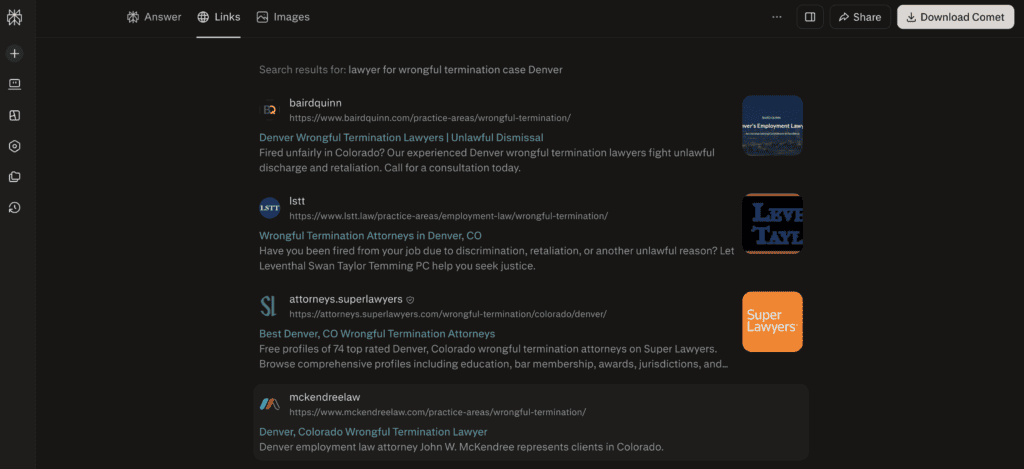
We assumed that meant Perplexity was reading our location. It was not. We asked the same question from Chicago five days later and got Bolek Besser Glesius, Chandra Law, Mansell Law and Marshall Forman, five Ohio firms in a nine-source answer. We asked a third time, still from Chicago, and got six California firms instead. Not one Illinois practice appeared in either run.
ChatGPT, meanwhile, answered the same question with usa.gov and FindLaw and named nobody at all. The lesson is not that Perplexity is local. It is that Perplexity will hand a prospective client a named firm while ChatGPT hands them a government page, and the named firm may be a thousand miles away.
The Firm That Owns an Entire Query
Duwel Law, a Dayton, Ohio practice, is cited six times in a single Google AI Mode response about recognizing wrongful termination. Not once among a list of sources. Six times, carrying the answer. Perplexity cited the same page on the same question.
That page is a blog post from March 30, 2026, at roughly 1,100 words. It opens on emotion rather than an answer. Its H2s are statements, not questions. It carries no individual attorney byline, no external authority of any kind, and no FAQ section.
By most published checklists it should not be winning. What it has instead is clean sectional structure, bolded key terms, scannable lists, a logical progression from broad concept to specific action, and unambiguous geographic grounding in Dayton and its surrounding counties. It is easy for a machine to take apart and quote, which is what separates pages that get cited by AI search from pages that do not.
The Seats Are Open, and Non-Lawyers Are Taking Them
AISO Studio, a company that sells AI-visibility auditing and therefore has a commercial interest in the finding, scored 299 employment law websites in March 2026. The average classic SEO score was 90 out of 100. The average answer-engine readiness score was 43 out of 100. One site out of 299 earned an A grade, and one in five had no schema markup at all.
Employment firms have spent a decade getting good at the channel that is losing share. Meanwhile business.com was cited six times on the at-will firing question, HR Acuity, an HR software vendor, was cited on hostile work environments by two engines, and our queries also returned Indeed, Tulane University, Avvo, Facebook, YouTube and Reddit. Employer-side software and business media are answering employee-side legal questions, because they publish clean definitional content while most firms publish service pages.
The engines do not even agree on when a federal agency should win. ChatGPT and Google AI Mode both gave the hostile work environment definition to the EEOC almost entirely. Perplexity did not cite the EEOC once on that question.
What This Means for a Firm Deciding Where to Spend
Start with the questions the EEOC and the Department of Labor do not answer: what the process costs, how long it takes, whether a set of facts is worth filing on, what happens to your job while a charge is pending, and what your state adds on top of federal law. Those have no institutional owner on any engine.
Write the answer before the empathy. Duwel Law wins despite its narrative opening, not because of it.
Ground the content in a city, a state and a statute, and organize it so related pages support each other rather than compete, which is what topic clusters are for. Geographic specificity is not what makes an engine serve you to a nearby searcher, because it does not reliably do that. It is what makes a page unambiguous enough to quote, and the pages that get quoted most in our testing name their county as readily as their state.
Then check all three engines separately, because the answer engine optimization work that fixes one will not automatically fix the other.
Frequently Asked Questions
Which AI engine should an employment firm prioritize?
Perplexity and Google AI Mode, because ChatGPT cited no law firm on any of our six questions. Optimizing for ChatGPT first means competing for slots it currently gives to government sites.
Is it worth creating content for ChatGPT at all?
Yes, but expect indirect returns. ChatGPT cites the reference sites and government pages your prospective clients read next, so the realistic goal there is being the source those pages point to.
Does schema markup get a law firm cited by AI?
Not for Google. Its own guidance states no special markup is needed for AI features. Schema still earns rich results in classic search, which is a separate argument.
How often should a firm check its AI citations?
Quarterly at minimum, and always signed out. Perplexity returned a materially different set of firms depending on whether we were logged in, so an audit run from your own account largely reflects your own browsing history.
Where Lexicon Comes In
Running this audit takes a day. Acting on it is the harder part, and that is what we handle. At Lexicon Legal Content, our JD-trained writers turn a citation gap into the pages that close it: answer-first content built on the questions no federal agency answers, grounded in your state and your statutes, and screened against ABA Model Rule 7.1 before it reaches you.
To see which firms currently occupy the answers your prospective clients are reading, see our law firm content writing or contact us and ask for the three-engine citation check. You can reach our team any time at 877-486-8123.

David Arato, JD is the founder of Lexicon Legal Content, an attorney-owned legal content marketing agency serving law firms since 2012. He built Lexicon’s diagnostic approach to AI visibility around the same attorney credibility signals that answer engines actually check, and pushes every audit past surface fixes to the content and authorship gaps that keep firms unseen. David is a frequent contributor to Attorney at Law Magazine and Attorney at Work and a recurring guest on legal marketing podcasts.