

On January 12, 2026, Apple and Google confirmed a multi-year agreement for Google’s Gemini models to power Apple’s foundation models, including Siri, with an upgraded Siri expected during 2026. The assistant most Americans talk to is becoming a front end for the same model family that answers Google’s AI Mode.
That single change retires most of what has been written about optimizing for voice search, our own earlier work included. The target stopped being the microphone and became the model behind it, which is why answer engine optimization and voice are no longer two projects.
Voice search is no longer a separate channel, because assistants now run on the same models that power AI search. Asked as a spoken sentence, a legal question returned no law firms at all. Asked as a keyword, the same question returned five.
The conversational content most firms were told to write is aimed at the queries where firms currently get cited least.
Voice Search Stopped Being Its Own Channel
The agreement is multi-year and non-exclusive, and Apple’s own statement is that Google’s technology “provides the most capable foundation for Apple Foundation Models.” Reported figures on what Apple pays have not been confirmed by either company, so treat them as reporting rather than fact.
What matters for a law firm is narrower than the headline. When the assistant is a language model, a spoken question is not a special query type with its own ranking rules. It is a longer, messier prompt handed to the same system that answers a typed one, and it is answered by pulling passages from pages the model can read.
That means the old voice checklist, conversational long-tail keywords and a fast mobile page, describes hygiene rather than strategy. The question worth asking is which sources these models actually quote.
We Asked the Same Question Two Ways and Got Two Different Internets
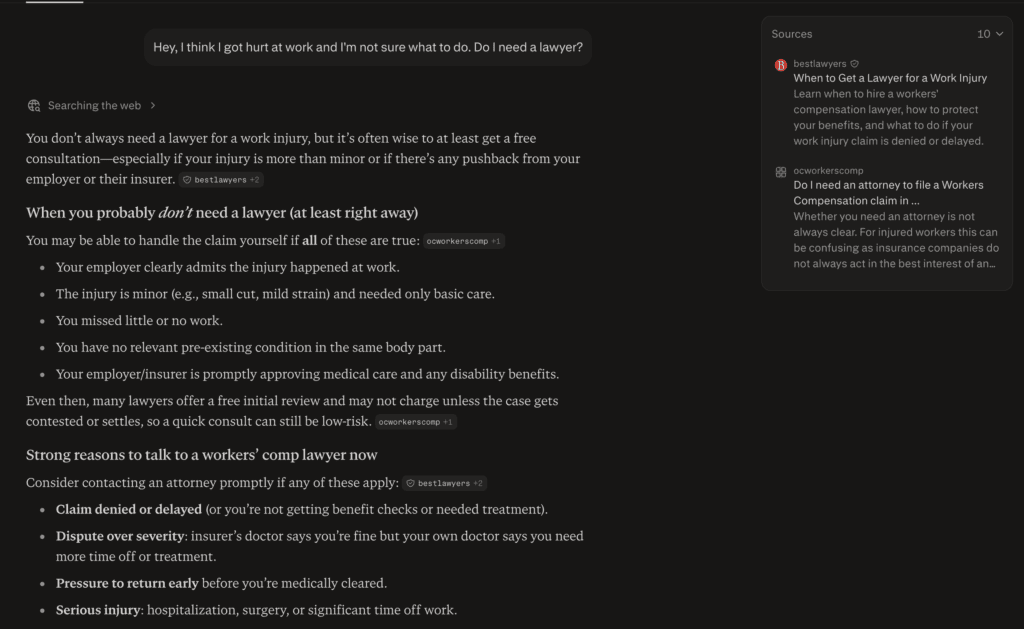
In August 2026 we put one legal question to Google AI Mode and Perplexity twice. Once as a person would speak it: “Hey, I think I got hurt at work and I’m not sure what to do. Do I need a lawyer?” Once as a person would type it: “work injury lawyer.”
| Engine | Spoken sentence | Typed keyword |
|---|---|---|
| Google AI Mode | Zero law firms. Best Lawyers, Reddit, YouTube | Five firms, most of them in Denver |
| Perplexity | 4 firms of 24 sources | 8 firms of 9 sources |
Google AI Mode answered the spoken version with three YouTube citations, three Reddit citations and a directory, and did not cite a single law firm. Asked the three-word version, it returned Dan Caplis Law, Babcock Tucker, Burg Simpson, Morgan & Morgan and Work Injury Law Group, alongside the Colorado Division of Workers’ Compensation and a local Reddit thread.
This is the opposite of the advice most firms have been given. The conversational phrasing that voice optimization has spent a decade chasing is currently the phrasing least likely to surface a law firm.

The Variable Underneath It
Phrasing is not really the cause. What decides these answers is whether a government agency owns the process being asked about.
Workers’ compensation is administered by federal and state agencies, and the spoken version pulled in the Department of Labor, OSHA and three separate state agencies on Perplexity. We found the same pattern in our employment law citation audit, where both ChatGPT and Google AI Mode handed the hostile work environment definition almost entirely to the EEOC.
The clearest demonstration came from a different question. Asked “my husband got arrested last night for a DUI and I don’t know what happens now,” Google AI Mode split its answer into two tracks: the licence process and the criminal case. The Colorado DMV was cited for the administrative track. Two Colorado firms, Gasper Law Group and Fife Luneau, were cited for the criminal one.
One answer, one question, and the agency and the firms each owned the half they actually own.
Video and Forums Are Taking the Conversational End
The spoken workers’ compensation answer in Google AI Mode was built on three YouTube citations and three Reddit citations. Not one law firm page appeared, not because firms have not written about workers’ compensation, but because what the model wanted was somebody explaining a situation rather than a page describing a service.
That is an uncomfortable finding for a content agency to publish, and it is worth publishing. Another blog post does not fix it. A firm that wants the conversational end of this needs to be present where the conversation happens, which means video content built for the same searches and short-form video for social alongside the website.
What This Means for a Firm Deciding Where to Spend
Stop running voice as a separate workstream. It resolves to the same models as the rest of AI search visibility, and a page built for assistants is a page built for AI Mode.
Own the questions no agency owns. Where a state agency runs the process, expect to lose the procedural citation and win the judgment call next to it: whether to file, what it costs, what happens to your job, when to bring in a lawyer.
Match the searcher’s location on the page itself. Google AI Mode returned Denver firms for a query that never mentioned Denver, and city and county specificity is what makes that possible.
Then check the conversational phrasings separately from the keywords. The two pull different sets of sources on the same question, so testing one tells you nothing about the other.
Frequently Asked Questions
Is voice search optimization still a separate thing in 2026?
No. With Siri moving to Google’s Gemini models, spoken queries resolve to the same systems that answer AI search. Optimizing for assistants and optimizing for AI search are now the same work.
Why did the conversational question return no law firms?
Because the model answered it with video, forums and a government process rather than service pages. Conversational questions often describe a situation, and models tend to answer those with explanation rather than representation.
Should a law firm still write FAQ and question-format content?
Yes, for readers and for extraction. Just do not expect question phrasing alone to earn a citation. The source mix depends far more on the topic than on how the question is worded.
Does Perplexity work differently from Google AI Mode?
Yes. Perplexity cited firms on the spoken question where AI Mode cited none, and returned out-of-state firms on a query where AI Mode returned local ones. Check both.
Run the Spoken Half Yourself
You can do part of this yourself in ten minutes. Ask an assistant the question your next client would say out loud, then read the source list it returns. If your firm is missing from it, you already know more than most of your competitors do.
What takes longer is sorting which gaps are worth a page. Some belong to a state agency no firm is going to outrank. Others are sitting open. Lexicon Legal Content has written for more than 300 law firms across North America, and that sorting happens before anyone writes a word.
Call 877-486-8123 for the spoken-query audit. If you would rather see the writing first, start with the writing itself, or tell us what you are up against.

David Arato, JD is the founder of Lexicon Legal Content, an attorney-owned legal content marketing agency serving law firms since 2012. He built Lexicon’s diagnostic approach to AI visibility around the same attorney credibility signals that answer engines actually check, and pushes every audit past surface fixes to the content and authorship gaps that keep firms unseen. David is a frequent contributor to Attorney at Law Magazine and Attorney at Work and a recurring guest on legal marketing podcasts.