
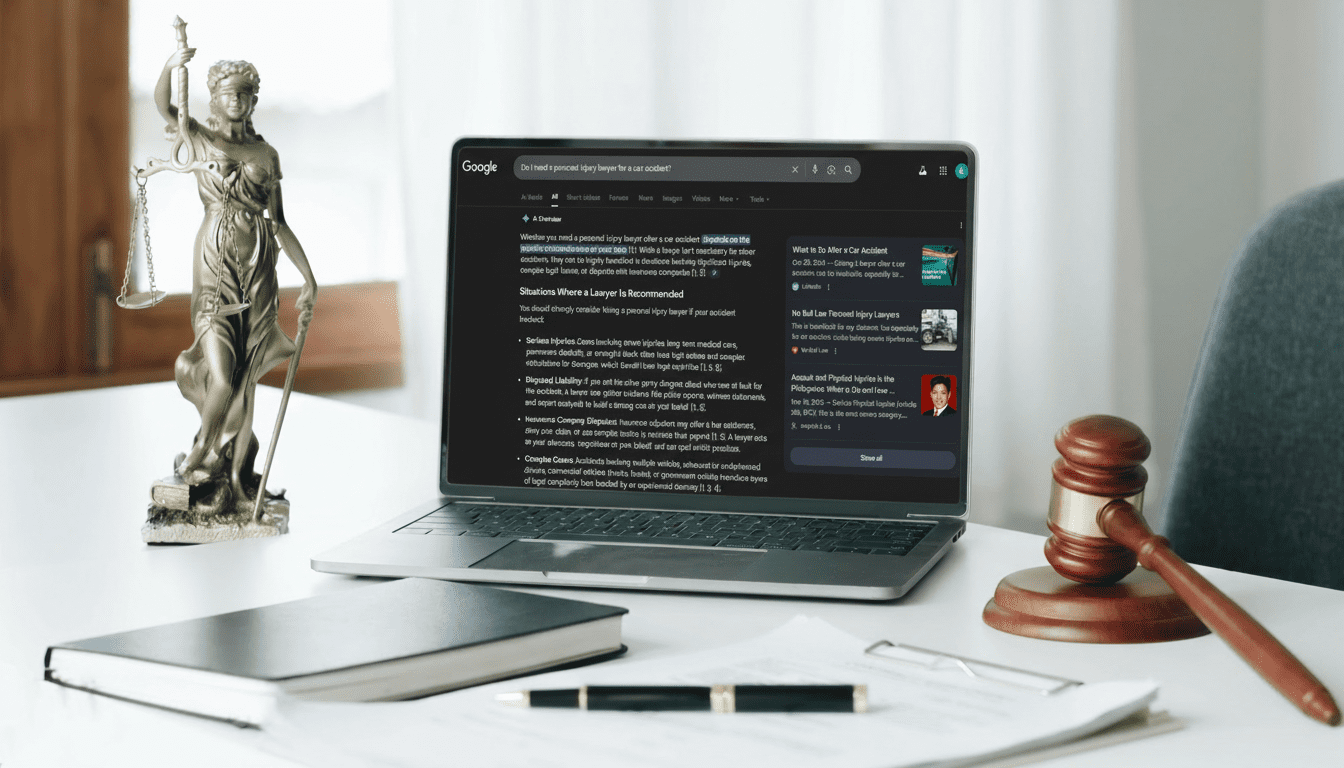
When a potential client asks ChatGPT “Do I need a personal injury lawyer for a car accident?” or Claude “What’s the statute of limitations for a medical malpractice claim?”, your law firm should be in that answer. Achieving these AI citations is the new frontier for client acquisition.
One of the most effective ways of getting into AI results is by regularly posting blog content that answers legal questions that people are searching for. Yet, most law firm blogs are written only for human readers. That’s a strategic mistake that costs you valuable AI citations for law firms, visibility, and clients.
This isn’t about replacing traditional SEO – in fact, data consistently indicates a significant overlap between organic and AI results. It’s about writing blog posts that serve both human readers and AI systems at the same time.
Here is the exact blueprint to optimize legal blog for AI and ensure your firm gets cited.
At Lexicon Legal Content, we leverage 13 years of law firm SEO experience to engineer content that consistently earns AI citations. This blueprint reflects our proven, data-driven approach.
Overview Summary
Law firms can earn AI citations by creating authoritative, structured blog content that answers legal questions directly. Using question-based headers, attorney credentials, and scannable formatting improves AI visibility, credibility, and client acquisition, while avoiding vagueness and inconsistent information.
Why AI Citations Are a Non-Negotiable for Modern Law Firms
Just a few months ago, attorney AI citations were a novelty. Today, they are a powerful client acquisition channel.
When ChatGPT, Claude, or Gemini answers a legal question, they pull from trusted, authoritative sources. These AI systems prioritize YMYL content, “Your Money or Your Life” material where accuracy is critical. Legal advice sits at the very top of this category.
An AI system will not risk citing a questionable legal blog. It needs content that demonstrates clear law firm E-E-A-T (Experience, Expertise, Authoritativeness, Trustworthiness). This creates a massive advantage for law firms that know how to adapt and produce AI-friendly legal content.
The 4-Step Formula for AI-Citation-Ready Legal Blog Posts
Step 1: Start with a Direct, Unambiguous Answer (2-3 Sentences)
AI systems are designed to extract concise, definitive answers. They look for this information immediately, making this the first step to get cited by Claude and other AIs.
- Don’t bury the lead. Avoid vague introductions.
- Do lead with the answer.
Weak Example: “The statute of limitations can be a complex issue that depends on many different factors in a personal injury case…”
Strong Example: “In California, the statute of limitations for most personal injury cases is two years from the date of the injury. This means you have a strict two-year deadline to file a lawsuit. Missing this deadline will almost certainly prevent you from recovering financial compensation.”
This format does two things: it signals to the AI that you’ve answered the question directly, and it gives human readers the instant clarity they crave.
Step 2: Structure Your Headers as Direct Questions
Search engines understand keywords, but AI systems understand user intent, a key principle of AI search optimization for lawyers. They parse your headers to see how your content maps to real-world questions.
- Instead of: “Overview of Statutes of Limitations”
- Use: “What is the Statute of Limitations for a Personal Injury Claim in California?”
This question-based format acts as a direct signal of semantic relevance, making your content easier for AI to understand, categorize, and cite.
Step 3: Include Full Attorney Attribution with Verifiable Credentials
This is the most critical step for boosting your law firm E-E-A-T. A blog post without a verified attorney byline is treated as generic marketing content by AI systems, killing your chances for legal blog content AI citations.
Your byline should include:
- Your name
- Years of Practice in the Relevant Area
- Any Relevant Certifications or Board Admissions
- Your Law Firm Name and Location
Including a bar number and specific experience transforms a generic article into a trusted, authoritative signal. For AI systems assessing “Your Money or Your Life” content, this is not a minor detail, it is the foundation of your credibility and AI visibility.
Step 4: Format for Scannability and Data Extraction
Use a clean, logical legal blog structure for AI that both humans and AI can easily digest.
- Opening Statement: Your direct answer.
- Why It Matters: Brief context for the rule.
- Specific Facts/Rules: Use bulleted or numbered lists.
- Client Action Steps: Provide clear, actionable next steps.
This structure is perfectly suited for “featured snippets” in Google, which have a high correlation with AI overviews. You win in both places with properly optimized legal blog for AI.
Common Mistakes That Will Get Your Content Ignored by AI
- Vagueness: Phrases like “it depends on several factors” signal uncertainty. Be definitive first, then explain nuance later.
- Burying Key Information: If your main answer is in the fourth paragraph, the AI may not identify it as the primary response.
- Inconsistent Local Information: Saying you’re based in “Phoenix” on one page and “Arizona” on another creates entity confusion for AI. Be precise and consistent.
Frequently Asked Questions
Do law firms need a blog to get cited by AI like ChatGPT?
A blog isn’t mandatory, but it’s an efficient way to build AI citation authority. Practice area pages work too, but blogs let you systematically answer hundreds of specific questions potential clients ask AI. Fresh content signals ongoing expertise.
What is the ideal blog post length for AI citations?
Length doesn’t matter, comprehensiveness does. An 800-word post with direct answers, clear structure, and attorney credentials outperforms a vague 2,500-word post. AI systems prioritize answer quality and directness over word count every single time.
Why is an attorney byline critical for AI visibility?
Attorney bylines prove E-E-A-T signals AI systems verify. Posts without specific credentialed authors get treated as generic content. Multiple attorneys bylined on interconnected topics demonstrate deeper, collective firm expertise across practice areas to language models.
How can I track if my content is getting cited by AI?
Test manually by asking ChatGPT, Claude, and Perplexity your target questions. Use SE Ranking to track mentions in AI responses. Monitor Google Search Console for “Discover” traffic surges, which often signal AI Overview features and generative search visibility.
Ready to Get Your Firm Cited by AI?
Your competitors are already optimizing their legal blog for AI. Every week without a proper strategy is a week your firm is missing from the answers when potential clients ask for help.
The firms winning in AI search right now aren’t the ones with the longest blogs—they’re the ones with the smartest content architecture. They’ve built topical authority around specific practice areas. They’ve credentialed their attorneys properly. They’ve structured their content for extraction.
You can do the same.
Start here: Write one high-intent blog post using this 4-step framework. Use a real legal question your clients actually ask. Include full attorney credentials. Structure it for scannability. Then test it. Ask ChatGPT, Claude, and Perplexity your target question and see if your firm appears.
See the difference. That’s proof of concept.
If you’re ready to systematize this across your entire practice—to build the content architecture that dominates AI search and attracts qualified clients consistently—let’s talk.
Ready to dominate AI search? Call us at 877-486-8123 or contact us online today. Let’s make your firm the answer clients see first—in Google, in ChatGPT, and everywhere else they search for help.
Key Takeaways
- Begin each blog with a concise, unambiguous answer to the legal question.
- Use headers phrased as direct questions to match user search intent.
- Include full attorney credentials, bar numbers, and relevant experience for authority.
- Organize content with scannable sections for easy AI and human reading.
- Avoid vague statements that could signal uncertainty to AI systems.
- Ensure consistent local and firm information across all pages.
- Prioritize clear, high-quality content over word count for better AI citation.
About the Author: David Arato, JD is founder of Lexicon Legal Content, an attorney-owned legal content agency serving law firms since 2012. As AI-generated answers reshape how clients discover legal help, David has spent the last two years analyzing what gets cited by ChatGPT, Gemini, Perplexity, and Google AI Overviews—and helping law firms dominate both traditional search and generative AI visibility through strategic content architecture. He specializes in attorney-written content and is a frequent podcast guest on legal marketing topics and contributor to Attorney at Law Magazine and Attorney at Work.