
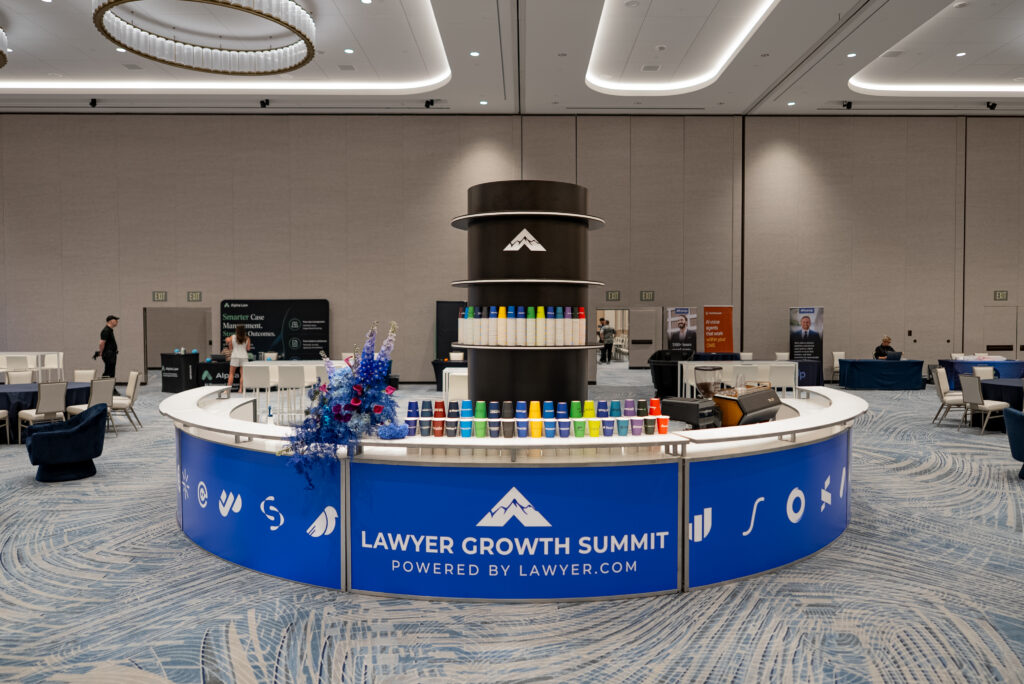
Lawyer.com held its third Lawyer Growth Summit at the Fontainebleau Las Vegas July 15 to 17. There was no program on the chairs. There was a 63-page workbook full of scoring tables and blank fields, with a printed instruction to be honest about the answers.
The room was mostly firm owners and managing partners rather than marketers, which changed the questions people asked. I run Lexicon Legal Content, a content and search visibility agency for law firms, so I spent two days watching a room of owners work through problems my team looks at most weeks of the year. The workbook is a free download now. These were my conclusions.
One pattern ran under all of it. The firms in that room were considerably better at practicing law than at describing what they do, measuring whether it works, or handing any part of it to someone else. Nine sessions arrived at that from nine directions.
Colleen Joyce, Lawyer.com’s CEO and the Summit’s founder, keynoted twice, opening day one and again after lunch on day two, and both talks came back to the same frame she sets out on page five. Your firm is a system. Growth comes from strengthening every part of it, not from being excellent at one.
Branding and Valuation Are the Same Conversation
Sean Callagy of Callagy Law keynoted early on day one, and his track record is the reason a room of owners sits still for him. His first firm went from one employee to forty inside a year. His second went from one to a hundred in three. He is also one of only two attorneys in the country to land two Top 100 national jury verdicts between 2014 and 2016.
The panel that followed, Be Known or Be Forgotten, put Gordi Mikalacki of Elmm Law Group, Brandon Rafi of Rafi Law Group and Jo Stephens of Law Firm Sites together, moderated by Jenn Gore of Evergreen Business Coaching.
Its exercise scores eight statements about your brand. Seven are the questions you would expect. The eighth asks whether your brand would still have value beyond the founder.
A firm whose reputation lives entirely in one person’s name has a marketing problem and a valuation problem simultaneously, and nobody notices the second until they try to sell, take on capital, or hand the firm over. The marketing spend and the exit strategy turn out to be the same decision.

What I would actually do about it is narrower than most branding advice. Stop publishing everything under the founder’s name. If one person is the author, the quote, the video and the bio on every page, you are building an asset that walks out the door with them. Give the other attorneys real bylines and real subject areas.
Visibility Is a Bookkeeping Problem Before It Is a Content Problem
Tim Stanley gave the keynote closest to my own work. He founded Justia and co-founded FindLaw before that, so he has built the infrastructure of legal search in two separate eras. Very few people can say they have watched this shift happen twice.
His session inventories the signals a firm gives off, then hands you a page called Build Your AI Footprint that asks what proof about your firm already exists online and what proof is missing.
I run that audit for clients most weeks of the year. Firms that mark those signals weak are almost never losing on writing quality. They are losing on bookkeeping. The firm name appears three different ways across directories. Half the attorney bios stop at a law school and an admission year. The credentials that would settle the question exist in exactly one place, on the firm’s own website, where nothing corroborates them. A search engine has to establish who you are before it can judge whether you are any good, and plenty of firms fail the first step while assuming they failed the second.
AI answers and traditional rankings now pull from different signals, which is a large part of why firms stay invisible while their rankings hold steady. The signals raters verify are mostly clerical, which is exactly why they get skipped.
Two things I would tell anyone filling in that page. The first is that the answer to “what proof is missing” requires going and looking, and almost nobody has looked, so budget an afternoon rather than ten minutes. The second is a caution about the whole category. Engine behavior moves constantly, and our own audit runs have returned contradictory results on the same query weeks apart. Build the footprint because complete and consistent information about your firm is durable. Do not build it against any single engine’s current habits, because those expire.
You Can’t Hire Your Way Out of Missing Process
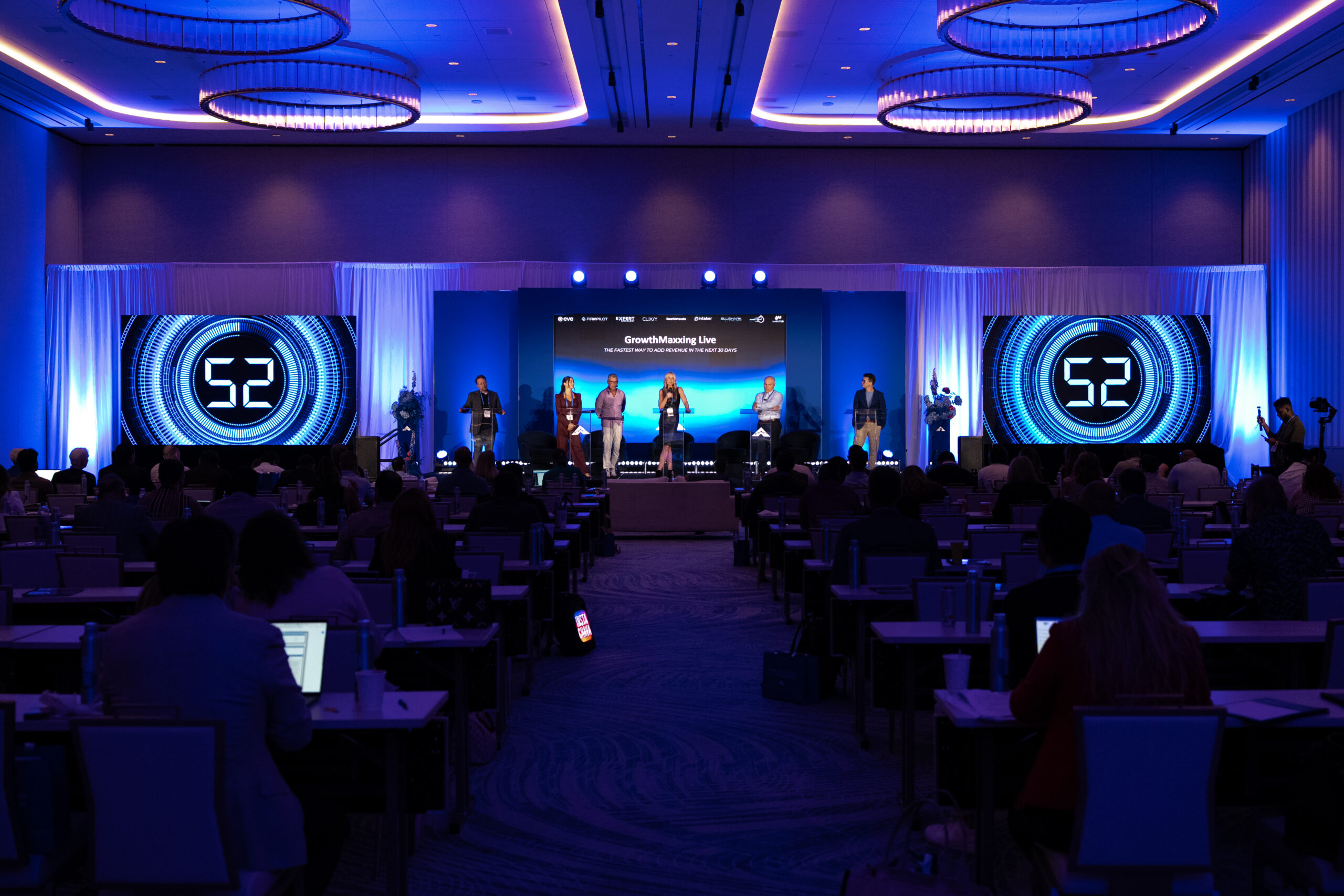
GrowthMaxxing Live was new this year, run against a countdown clock by Corey Vandenberg of Clixsy, Glenda Quiroz of Solvo Global, Melissa Breen of Eve and Rafi Arbel of Market JD, moderated by Paul Faust. The format forced a single decision out of every assessment instead of letting the room leave with a list of options.
The exercise I keep thinking about asks you to list five tasks you personally completed yesterday, then sort them into work only you can do, work someone else could do, and work nobody can take over because no process exists yet.
Most owners go in expecting the middle pile to be the biggest. It is almost always the third. You are not short of people. You are short of written process, and no amount of hiring fixes that.
I would go further than the exercise does. The third pile is not a delegation backlog, it is a list of the things that will break the first time you are unavailable, and it is worth ranking by that risk rather than by how much time each one costs you. The task that takes twenty minutes a week but only you know how to do is more dangerous than the one that takes five hours.
Arbel made the observation from that block that I would put on a wall: too many inquiries never reach a resolution. You can win the search result, win the click, win the call, and still lose the case to a voicemail nobody returned. Intake closes the case, and it is the cheapest thing on this list to fix.
The AI Creative Lost, and That Is Not the Interesting Part
Nicole Bergen, COO and co-founder of Elevate Marketing Research, keynoted with fresh consumer research rather than opinion, and ran an A/B test of AI-generated advertising against human-made creative. The AI versions underperformed. Hers was the only session all week that tested a popular assumption instead of asserting one.
I would not read that as a permanent state of affairs, and I doubt she would either. The gap will close on the creative side, probably faster than anyone in that room expects.
The failure mode that will not close is a different one, and it is the reason my company exists in its current shape. Generative systems are already fluent enough to produce work that reads as competent and is wrong on the facts. The profession has a well-publicized example in the lawyers sanctioned for filing a brief built on cases that did not exist, invented by a chatbot and checked by nobody. That story traveled because it was embarrassing. The version that should worry a firm is quieter: a practice area page that states the wrong filing deadline, a blog post that cites a statute that was amended two years ago, a summary of a case that inverts the holding.
Nothing about that shows up in your analytics. It shows up when a client acts on it.
So the useful question is not whether AI can write your content. It is who checks it, against what, before it goes live. Zero-effort content is worthless. Confidently wrong content costs you clients.
Referrals Die in the Moments Nobody Wrote Down
Day one closed on trust, with Lawyer.com chairman Gerald Gorman, Scott Snellings of Snellings Law, Chris Rose of LegalFlare and Cara Rosenthal of Expert Radiology, moderated by Sameer Somal.
Their map walks the client relationship from before first contact through to reviews and referrals, and asks what happens now at each stage against what could be stronger.
Most firms can answer confidently for two or three stages. The rest run on whoever picks up the phone that day. A bad outcome rarely kills referrals. Undocumented stages do. You cannot improve a process that exists only as a habit.
The stage I would start with is the one firms skip entirely: after the case closes. It is the only moment when a client has the full picture of what you did for them, and it is the moment almost nobody has a documented process for. Everything a firm wants from a former client, the review, the referral, the testimonial, the case study, is available in that window and expires quietly.
Case Value Is Built Before the Other Side Knows
Mike Alder of AlderLaw keynoted on maximizing case value, built around demand discipline, investigating as though the case depends on it, and sustaining weekly pressure.
The evidence record that determines what a case is worth gets built early, before the other side understands what is being assembled. By the time you are negotiating, the number is already set. It was set months earlier, in the record you built, and that holds whether or not you practice on the plaintiff side.
I will not pretend to add anything to Alder on case strategy. What I took from it sits next to my own work: the discipline he describes is the same habit that makes a firm easy to write about. Firms that document early have facts, outcomes and detail available when it is time to build authority. Firms that do not have to reconstruct everything from memory, and it shows.
Peer-Nominated Recognition Is a Visibility Asset

Lawyer.com used the Summit to present the first Lawyer Growth Awards, honoring winners and finalists live across six categories, from Marketing and Business Development through to the flagship Growth Firm of the Year.
Nominations were peer-submitted and self-nominations were not accepted. As Joyce put it in the announcement, “The legal industry has always celebrated legacy. We built the Lawyer Growth Awards to celebrate what’s next, and we made it peer-nominated by design.”
That matters more than a badge for the footer, for a reason that connects back to the Stanley session. Third-party recognition is one of the corroborating signals search engines and AI systems lean on when deciding which firms to name. An award your peers nominated you for is evidence that exists somewhere other than your own website, which is precisely what most firms are short of.
If you won or placed, the mistake is treating it as a graphic. Put it on the firm’s about page with the year, the category and a link to the announcement, get it into your directory profiles, and make sure the announcement itself is indexable. An award nobody can verify does none of the work.
Most Firms Have Not Named What They Are Optimizing For
Day two moved to ownership and money, and it was the sharper of the two days.
Bill Biggs opened with a leadership workshop that starts by asking whether you are the visionary or the integrator in your own firm, then asks for one committed action within seven days. It ran with a full forty-five minutes of questions afterward, which is a reasonable measure of how much the room wanted it. Most firm owners answer visionary and then describe a week that is entirely integrator work.
From Local Practice to Market Leader followed, with Philip Pendergrass of Turnbull, Moak & Pendergrass, Tim Paoli of Michael Kelly Injury Lawyers, Josh Sanford of EKSM and Angel Reyes of Reyes Law, moderated by Shireen Hilal.
Then the capital sessions. The Next Billion-Dollar Shift, with Viraj Bindra of Finch, Bear Federman of Atticor and Jeremy Alters of ClaimAngel, covered MSOs, outside investment and succession, and its sorting exercise separates firms optimizing for liquidity and speed from firms optimizing for independence and continuity.
Almost nobody has made that choice explicitly. They have made it by accident, across a decade of small decisions, and then feel stuck without being able to say why. The panel also named the hybrid path for partnerships where senior and junior partners want opposite things, which is the situation most firms are genuinely in and the one nobody wants to raise at a partners’ meeting.
The mass tort session with Andy Rogers of Shield Legal, Mark DiCello and Mark Abramowitz of DiCello Levitt produced the sharpest line of the two days: capital should follow confidence, not hope. It reframes mass tort participation as an investment with reporting obligations rather than a practice area you staff from scratch.
The Summit closed with Alex Elman and Anthony Massaro of EvenUp alongside Nicholas Norden and Zachary Leacox of Norden Leacox, auditing where AI actually belongs in a legal workflow. The distinction it forces is the useful part. A task being time-heavy does not make it an AI task. Usually it means nobody has written the process down, and automating something undocumented just produces faster chaos.
The Page Nobody Fills In
Sixty-three pages of diagnosis end at a page with four fields on it. What will you implement tomorrow, what is the first step, who owns it, and how will you know it worked.
That is the page most likely to be left blank, and it is the only one that does anything.
Ideas without a named owner and a date are a well-catered weekend.
What I Would Do First
Take your lowest score, run one honest audit against it, and give one person a deadline. None of that requires a ticket to next year.
The Next Level Growth Playbook is free and it is the same material we worked through in the room, so start there. Registration for 2027 is already open, and on the strength of this year I would book early.
If your lowest score landed on the AI footprint page, that is the audit we run at Lexicon. We will show you which claims about your firm currently exist in a form a search engine can read, which ones are missing, and which ones are wrong. If the gap turns out to be the pages themselves, that surfaces in the same pass. One firm’s year of results shows what it compounds into. Start with a baseline visibility audit.
Thanks to Colleen Joyce, Kristin Smith, Brian Farrell, Ashley Muzzillo and the Lawyer.com team, to the sponsors who filled the exhibit hall including Neostella and Records On Time, and congratulations to the first class of Lawyer Growth Award winners. See you in 2027.


David Arato, JD is the founder of Lexicon Legal Content, an attorney-owned legal content marketing agency serving law firms since 2012. He runs visibility audits for firms across North America and finds the same pattern most weeks: the information a search engine needs to identify a firm is scattered across directories, inconsistent, or missing altogether. David is a frequent contributor to Attorney at Law Magazine and Attorney at Work and a recurring guest on legal marketing podcasts.